STRATEGY PILLAR
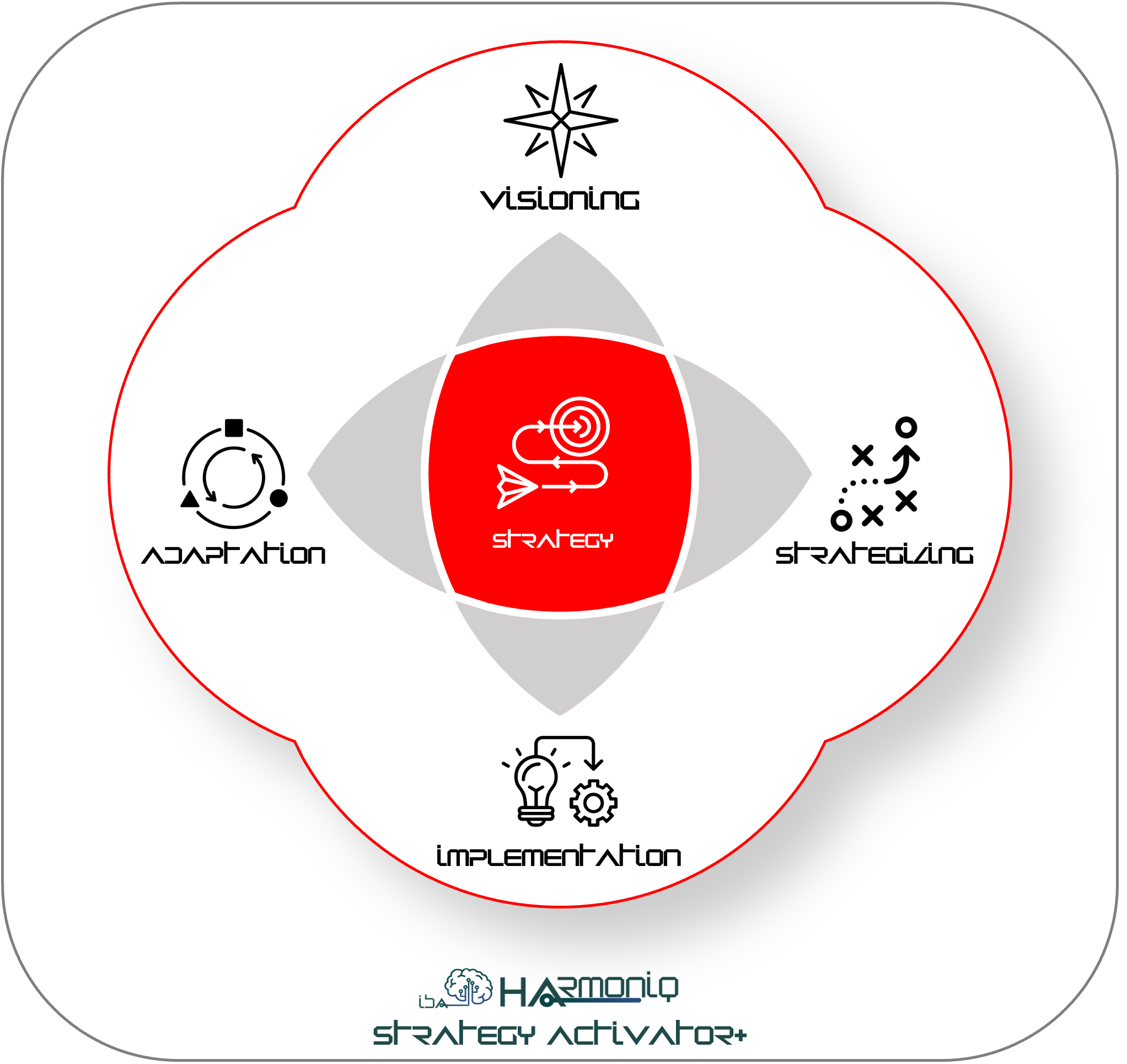
In the Harmoniq organizational model, strategy is not considered a static exercise or a multi-year plan to be filed away in a drawer. Instead, it represents the vital connection point between the organization Purpose and the implementation actions necessary to pursue it, constantly balancing executive efficiency with operational dynamism.
Adopting a proactive and structured strategic approach guarantees the company four fundamental benefits:
- Direction and clarity: providing a shared roadmap for the vision and strategic objectives.
- Organizational alignment: unifying action toward objectives, drastically reducing inefficiencies and duplication of efforts.
- Competitive advantage: anticipating and responding to new market trends and emerging needs.
- Long-term sustainability: focusing the organization beyond immediate results toward systemic proactivity and resilience.
The definition and continuous updating of Strategy is the task of the Strategy PA, which leverages federators as direct reports in order to align the entire organization.
The 4 Strategy Activator+
Harmoniq's corporate strategy constantly develops and evolves through four reference operational activators (Strategy Activator+), which guide the flow from conceptual design to operational grounding and its verification:
1. Visioning: developing the Projection of the Future
Visioning has the goal of imagining, describing, and contextualizing the desired future. It develops the projection of the future that the enterprise wants to contribute to creating, representing the long-term "dream" and the imprinting of the strategic direction. This activator develops through three fundamental operational steps:
-
- Purpose Explanation: defining the Purpose and Purpose Stratification that guides the reason for being of the organization and creates holistic alignment.
- Generate Awareness Contextualization: linking the Vision to Situational Awareness.
- Three Horizons Prioritization: declining the vision in relation to three horizons: Now, Near, Future.
The Three Horizons Framework
The strategy, and consequently all organizational structures, are structured according to 3 reference horizons: Now, Near & Future.
-
- Horizon 1 - Sustain and Defend (now): focuses on the core business, i.e., the products and services that generate the company's current revenues. The goal is to maximize efficiency, optimize existing offerings, and protect market share.
- Horizon 2 - Expand and Explore (near): pushes beyond the core, exploring adjacent markets, new technologies, and possible extensions of the business model. It focuses on structured experimentation, learning, and identifying the most promising growth opportunities.
- Horizon 3 - Transform and Create (future): enters the unknown, exploring completely new business models and disruptive innovations. It serves to prepare for the future, investing in long-term bets and developing the capabilities needed to face the times ahead.
2. Strategizing: the Business Handshake and Adaptive Budgeting
Strategizing implements the Business Handshake, creating the bridge between vision and implementation. It defines a dynamic process of creating, proposing, and implementing strategic goals. This activator develops through the following operational steps:
-
- Goal Explanation: defining strategic goals in support of the Vision.
- Business Handshake: negotiating goals with and between the Enabling structures (Proactive Enterprise and Adaptive Design) and Delivery structures (Value Flow).
- Strategic Roadmap: creating a Strategic Roadmap that allows monitoring the achievement of objectives and reviewing them based on results and contingencies.
- Adaptive Budgeting: forecasting the overall budget, which is progressively allocated (funding) and revised at regular intervals, typically on a quarterly basis.
- Adaptive Offering: defining the offering lines necessary to proactively accompany the strategy.
The Paradigm Shift: Adaptive vs. Traditional Budgeting
Budgets are the channels from which to draw "just-in-time" financing, which is when one is ready to start the development of Initiatives and Value Increments in support of specific objectives. There is a fundamental difference between budgeting and financing residing in the goal:
-
- FINANCING: Sourcing of resources: how to obtain the necessary money.
- BUDGETING: Planning and Allocation of resources: what to do with the money you have.
The objective is: To structure a budget management capable of adaptively financing developments in support of strategic objectives.
This paradigm shift is reflected in a series of operational consequences:
-
- Strategic Agility: ability to respond instantaneously to market changes.
- Resiliency: economic shocks (e.g., demand fluctuations) are better absorbed.
- Dynamic Fast-Track: rapid approval mechanisms for out-of-cycle investments.
- Focus on Burn Rate: monitoring the spending velocity rather than a fixed maximum ceiling.
- Efficiency: money is spent only where really needed, reducing end-of-year waste.
- The budget is not an acquired "spending right" at the beginning of the year, but rather acquired On-demand, when a value opportunity is identified.
Advantages of Adaptive Budgeting
The main advantages encountered with the adaptive approach to budgeting are:
-
- Resources flow where needed, when needed (Dynamic Resource Allocation).
- Plans are continuously reviewed, utilizing real-time feedback and relative performance indicators.
- Targets are ambitious and relative to the market, not tied to fixed bonuses.
- People act and coordinate in the use of funds based on results.
- Choices are made in relation to value contribution, not on compliance with spending limits.
3. Implementation: Translating Objectives into Concrete Value
Implementation develops Value Increments, concrete manifestations of widespread entrepreneurship. It defines the process that gives life to solutions, aligning resources, organizational structure, and corporate culture to achieve objectives. This activator develops through the following operational steps:
-
- Bottleneck Mapping: applying the Theory of Constraints (TOC) to identify undesirable effects and transform them into intermediate objectives.
- Initiative Collection: the achievement of strategic objectives goes through the definition and implementation of specific Initiatives.
- Value Flow: each initiative is associated with a Value Flow that develops around the Zero Distance principle.
- Value Increment: initiatives produce Value Increments, defining a Value Stream capable of continuously releasing value to the reference stakeholders.
- HAI Ethic: implementation can leverage AI tools, while always maintaining ownership in the hands of human players and in compliance with the associated ethics.
4. Adaptation: the Art of "Planning While Walking"
Adaptation is the art of "planning while walking", constantly leveraging feedback. The goal is to confute one's own strategies, operational structures, and processes in response to changes in the internal and external environment. This activator develops through the following operational steps:
-
- Strategic Roadmap Review: based on the results obtained (evaluation is typically quarterly) and current information, the strategic Roadmap is reviewed, confirming, revising, or replacing objectives.
- Risk Assessment: the Risk Assessment activity allows identifying, measuring, and evaluating threats and vulnerabilities of the roadmap in relation to risk evidence.
- Investment Review: when a Value Flow is showing exceptional results, it can receive greater resources at the expense of less performing Value Flows.
- WoW Evolution: operational results are fundamental to feed the WoW Evolution Backlog and ensure that the Way of Working (Ways of Working) evolves along with the strategy.
Without human intelligence, there is no utility or purpose for artificial intelligence