
Harmoniq is the organizational model in which different forms of intelligence energize the potential of the organization to make it Dynamic and Efficient.
The model embraces the philosophy of Intelligent Business Agility, working on the intrinsic tension that develops between the need for stability, control and efficiency (Efficiency) and the urgency of differentiation, adaptation and innovation (Dynamism).
Its implementation gives rise to a hybrid organizational architecture, in which an autonomous operational networkand lean governance mechanisms coexist, supported by shared platforms at the company level, allowing for the safe and effective inclusion of AI at all levels.
As with any model, Harmoniq is the map, not the territory, and success depends on leaders' ability to navigate the inevitable ambiguities wisely, assisted, but not overwhelmed, by artificial intelligence.
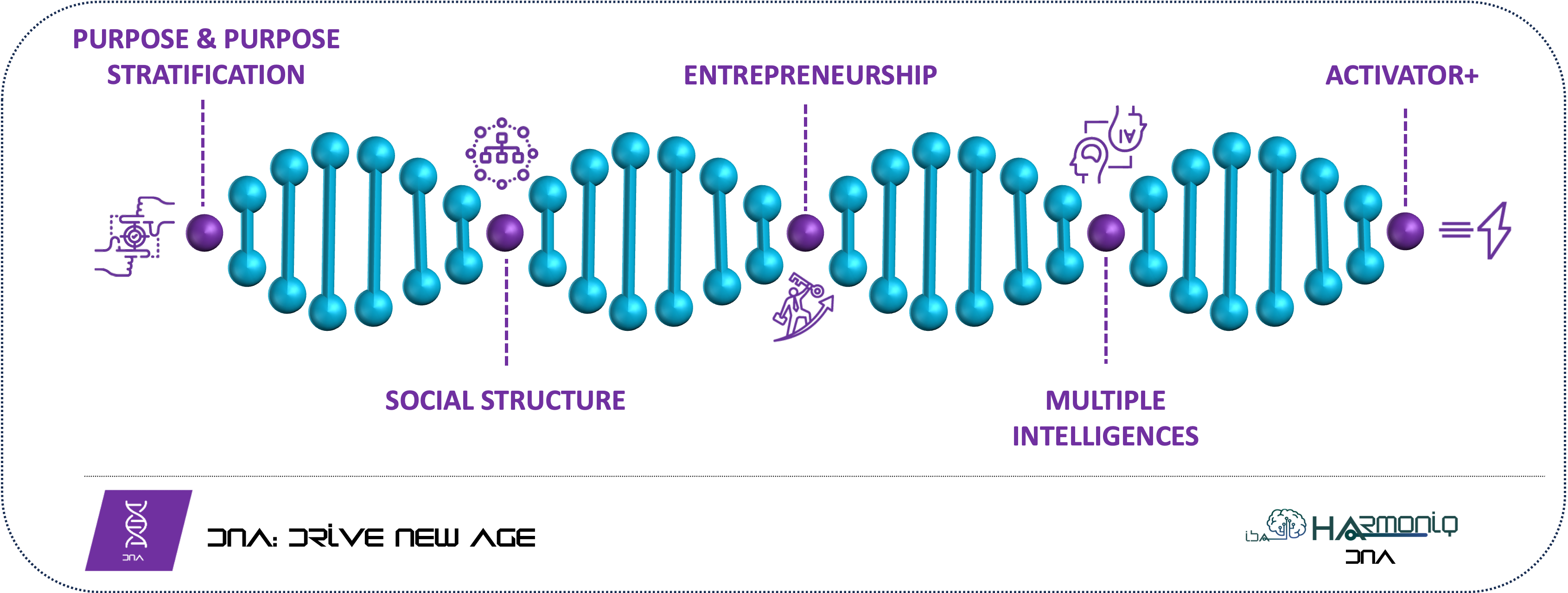
Harmoniq DNA: Drive New Age
Harmoniq integrates efficiency mechanisms without stifling dynamism.
In practice, it is possible to say that Harmoniq aspires to create a sort of "scalable adhocracy": maintaining adaptive and innovative structures (similar to internal mini-adhocracies), connecting them through common governance and shared platforms (calling for standardization and sharing).
For example: a Harmoniq-Empowered company might have self-organized teams dedicated to innovative projects (adhocratic setup), but at the same time provide centralized support functions or methodological guidelines common to all teams.
In "Mintzbergian" terms, Harmoniq seeks to tie together the islands of creativity (adhocracies) with a bridge that guarantees coherence and exploitation of synergies at the company level, contemplating an organizational modularitythat allows to increase or decrease the degree of decentralization and autonomy depending on the context.
The glue between these souls are the Mindset and the Transversal Mechanisms (Forum+, Network+, etc.) that ensure that the organization does not shatter.
Harmoniq can be seen as an adaptive meta-model: it provides guidelines on how to design the organizational structure, but leaves room for different configurations depending on factors such as the target market, the dominant technology, the company size, etc.
The model declines the four dimensions of Intelligent Business Agility in an operational way, overcoming the limits of "traditional" agility:
- Market-Fit Agility
- Impact on Harmoniq: ability to interpret and anticipate market needs, not just react.
- Critical Analysis and Implications: move beyond the reactive concept of "Customer Centricity" to embrace "Predictive Customer Intelligence". It involves the heavy use of Data Analytics to reduce time-to-pivot.
- Technological Agility
- Impact on Harmoniq: flexibility of the technical architecture to support rapid changes.
- Critical Analysis and Implications: requires the shift to composable services and architectures. Without this, organizational agility is held back by technical debt.
- Organizational Agility
- Impact on Harmoniq: fluid and reconfigurable structures (Delivery Network+, Squad+, Tribe+).
- Critical Analysis and Implications: this is the most visible dimension, inspired by the agile-lean world and the applications of team topologies principles.
- HAI (Human-AI) Agility
- Impact on Harmoniq: symbiosis between human and artificial intelligence.
- Critical Analysis and Implications: it is the real differentiator. It introduces AI not as a tool, but as a "Player", raising unprecedented questions of ethics, trust and organizational design.
At Harmoniq, it is essential to ensure that AI does not take the place of human judgment in critical decisions. AI should be seen as an augmentation, not as a substitute for people, particularly in leadership or decision-making roles.
In Harmoniq, a "human-in-the-loop" approach is explicitly adopted: the last word and the final responsibilityalways remain with the people, who act as supervisors of the activities carried out by the agents (or algorithms).
This means, for example, that AI systems can provide recommendations or carry out analysis, but strategic decisions are validated by a human decision-maker.
Linked to this, the model emphasizes the need for human verification and control over the outputs produced by AI. Human Players have the obligation to check and validate the results generated by AI Players, before they are used or operationally implemented.
An AI system that operates as a "black box" inaccessible to human control can undermine trust and lead to risks of bias or unwanted behavior. This is why Harmoniq adopts the principle that AI must operate in a transparent, ethical and verifiable way.
All players (human or AI) work in an environment of total transparency, cooperation and mutual respect for skills, with trust "designed into the system" from the start. This involves several concrete practices, for example:
- Traceability and Explainability: the algorithms and data used by AI Players must be accessible and interpretable by human teams, so that it is always possible to understand why a certain recommendation or automatic action has been produced. The information and logic of AI do not remain secret, but are shared with human team members (compatibly with technical complexity), promoting informed and conscious autonomy.
- Cross-validation: the results provided by AI are always compared and integrated with human ones. Harmoniq provides feedback loops in which AI outputs are screened by human members and combined with their input, so as to mutually improve both the automatic model and human decisions. This approach increases the quality of the solutions while increasing the team's confidence in the AI's suggestions, because they have verified their reliability.
- Ethics and Respect for Values: the use of AI takes place in compliance with shared ethical guidelines. For example, uses of AI that may discriminate or violate privacy are avoided, and metrics are adopted to monitor side effects (such as CoNI, Cost of Not Innovation, to measure the risk/opportunity of not innovating, balancing project portfolio choices).
By intentionally designing these features, it is possible to create an environment of collaboration and trust between humans and AI systems can grow. Trust is a fundamental enabler: only by trusting technology (without blindly relying on it) can people delegate tasks to it effectively.
A critical aspect is deciding how to introduce AI into daily operations: too rapid and uncontrolled adoption can lead to errors or inefficiencies, while too cautious use can lead to missed opportunities. Harmoniq embraces the "AI-First"principle in a pragmatic and incremental way.
In practice, the use of AI is encouraged wherever it can bring value, but following a stepless, experimental and reversible integration approach. Each new AI Player or AI feature is introduced through small, controlled experiments, so you can assess the impact, reduce risks, and back off if necessary.
This "start small" philosophy ensures that the organization learns step-by-step how to leverage AI, avoiding traumatic discontinuities.
In addition, Harmoniq emphasizes empirical feedback loops: the use of AI must strengthen (and not replace) the feedback and continuous improvement mechanisms typical of agile.
For example, if an algorithm generates a prediction about customer preferences, this does not eliminate the need to collect real feedback from customers. On the contrary, this AI output can be used as an additional input to be compared with the evidence collected in the field, and then update both human strategies and possibly the AI model (continuous learning concept).
Each planning and review cycle (planning, review, retrospective) considers both the human contribution and that of AI, integrating them, with the obligation for Human Players to verify the output of AI.
The explicit agreement on how people and artificial intelligence collaborate in AI-ACT, defined as part of the AI Pillar.
In summary, the adoption of AI in Harmoniq takes place gradually and methodically: new solutions are tested on a smaller scale, their results are measured (scientific approach) and only after validation do they extend to a larger scale.
This ensures on the one hand that we do not miss the innovation train (AI-First principle: always think if there is an AI option to improve a process), and on the other hand we maintain control and the ability to learn from mistakes while avoiding negative impacts on a large scale.
Without human intelligence, there is no utility or purpose for artificial intelligence