FOUNDATION LAYER
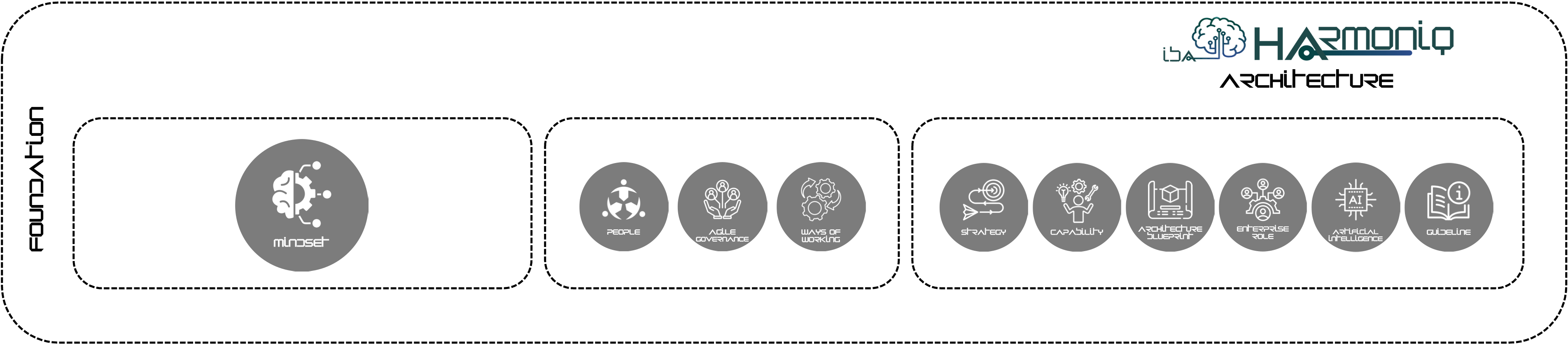
In the Harmoniq organizational model, to guide action and pragmatically direct the efforts of every single player, it is essential to start from a structured and ethically solid base: the Foundation Layer. This level encompasses the constituent elements of the organization—Mindset, Enablers, and Pillars—which work in unison to make the enterprise authentically proactive and harmonious.
The Harmoniq Mindset: The Grammar of the Organization
The Mindset in Harmoniq is not conceived as a simple code of ethics to hang on the wall. Instead, it represents the actual grammar through which the organization thinks, relates, and creates value every day. This system of thought is developed concretely through three specific Activators+:
- Values: the fundamental convictions of the company.
- Attitudes: defining how to think about and experience the organization.
- Promises: the concrete commitments made by all participants.
The IBA Enablers: Enabling Ecosystemic Agility
To allow the Mindset to translate into tangible behaviors, the Foundation Layer introduces three major categories of enablers, each focused on a vital dimension of the enterprise:
1. People Enabler
People are the vital center, the concentration of talent, and the real lever for innovation and value creation in the organization. This enabler focuses particularly on Smart Leadership and Talent Development. It is made concrete through two key activators:
-
- Culture: combining the company's beliefs, values, and attitudes to positively influence the behavior of all employees.
- Competencies: developing and valuing competent people who can effectively apply knowledge in their specific operational context to achieve success.
2. Agile Governance Enabler
This enabler ensures a clear, shared, and sustainable corporate direction for the entire company, generating operational flexibility and proactivity. It focuses on modern and proactive governance and the ability to navigate uncertainty. It is activated through:
-
- Antifragile: creating an antifragile and scalable organization that goes beyond traditional agility, using a flexible model supported by change agents.
- Modern Management: developing a management class capable of providing direction, inspiring people through self-awareness and an effective operating model.
3. Ways of Working Enabler (WoW)
The WoW focuses on the practical translation of the strategic vision into daily workflows that are effective, efficient, and adaptable. It is responsible for providing clear and shared guidelines and promoting the evolution and innovation of methodologies and processes. Its activators are:
-
- Execution: mastering everything that is needed, from skills to technicalities, to achieve results in the most effective way.
- Adaptation: the attitude to constantly rethink oneself to progressively improve performance and the quality of the results produced.
The 6 Pillars of the Organizational Model
The structural framework of the Foundation Layer rests on six engineering pillars that prevent chaos and guide evolution:
- Strategy: defined and continuously updated by the Strategy Process Area, which leverages federators as direct reports to align the entire organization. Strategy defines the organization's Purpose and the strategic objectives to pursue it. Its benefits include direction and clarity, organizational alignment (reducing inefficiencies and duplication), competitive advantage (anticipating new market trends), and long-term sustainability (focusing on proactivity and resilience).
- Capability: these represent the actual "muscles" of the company—the essential capabilities needed to guide the organization. They are characterized by transversality (common to the entire organization), designation (highlighting which Process Areas primarily impact them), and performance measurement (specifying how they are measured and what the minimum acceptable levels are). Identifying capabilities is the responsibility of Strategy and the Agility Areas, which monitor their performance and value in relation to the overall strategy.
- Architectural Blueprint: develops the aspects of Enterprise Architecture (EA) in a Lean-Agile key, embracing the dualism of scaling and agility. Coordinated by the Transformation PA to maintain a People & Value Centric focus, it acts as a social and cultural engine through co-creation and co-design with teams. It is explicitly People-Centric (built on roles, capabilities, and talents) and centered on the Learning Organization.
- Enterprise Role: defines the accountability of the key roles across the organization. It ensures clarity of responsibilities (reducing ambiguity, conflicts, and overlaps), strategic alignment of individual and cross-functional roles, and scalability and governance of the system through calibrated delegation and process optimization. The development of these roles is entrusted to the Transformation and People PAs.
- Artificial Intelligence: acts as a widespread amplifier at all levels, from strategic to operational. It requires strong Data Fluency to manage and feed organizational algorithms, the targeted training of local models to respond to specific needs, and the adoption of evolved usage patterns (such as conversational and agentic AI). The management of digital assets related to AI is entrusted to the Digital Governance PA.
- Performance: allows for the scientific evaluation of the efficiency and effectiveness of the overall organizational model. It is linked to three fundamental evaluation elements: Performance Domains (the main dimensions of observation), Capabilities (the capabilities supporting the system), and Metrics (the evaluation scales). The development of the Performance system is delegated to the Transformation and People PAs to ensure evolutionary congruence.
Without human intelligence, there is no utility or purpose for artificial intelligence