PROACTIVE ENTERPRISE LAYER
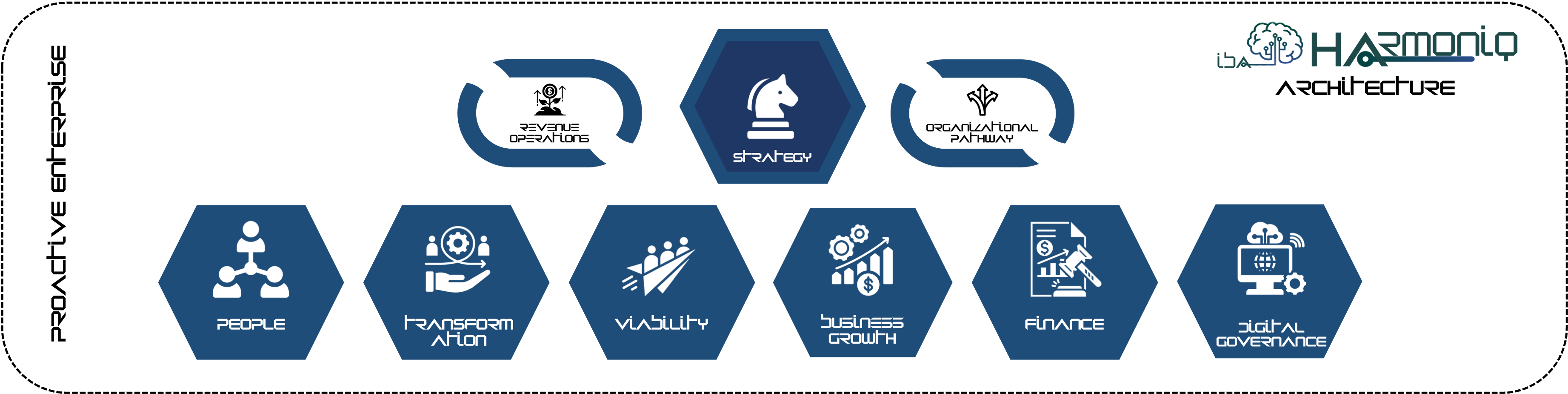
In the Harmoniq operating model, while the Foundation Layer represents the cultural baseline and the Value Flow is the operational arm delivering value to the market, the Proactive Enterprise Layer acts as the company's strategic brain and central support system.
Its fundamental purpose is to govern strategic aspects and efficiently scale all transversal and support services for value creation, enabling the organization to act proactively even before reactively.
Instead of relying on slow, disconnected functional silos, this layer operates as a dynamic "all-to-all" matrix where specialized areas collaborate constantly to synchronize customer demand with the actual action capacity of the enterprise, ensuring that every investment points directly toward the corporate Purpose.
The 7 Enabling Process Areas (EPAs)
To avoid bottlenecks and optimize competence distribution, the Proactive Enterprise Layer is structured into seven stable Enabling Process Areas (EPAs), each focused on a specific corporate capability:
1. Strategy PA (The Dynamic Rudder)
Responsible for continuously defining and recalibrating the company's long-term vision. It acts as the origin point of the Business Handshake, negotiating and aligning strategic goals with the operational autonomy of the Value Flows.
-
- Horizon 1 (Core Optimization): optimizes the current core business (allocating approximately 70% of resources) measured through ROIC, NPS, and market share defense.
- Horizon 2 (Emerging Growth): assesses and validates medium-to-long term growth options (approximately 10% of resources) through trend analysis, experimentation, and Proof of Concepts (PoCs).
- Horizon 3 (Transformative Options): explores radical options and disruptive business models (>5-10 years, approximately 20% of resources) to anticipate future competitive shifts.
2. Viability PA (The Strategic Value Orchestrator)
This area coordinates different Value Flows, managing dynamic budget allocation (Adaptive Portfolio) and minimizing strategic risk through a core principle: "Govern by risk, not by artifacts". It analyzes the performance of operational flows and balances the strategic trade-off between core business, growth, and innovation.
3. Business Growth PA (The Revenue Engine)
Maximizes the company's ability to generate profitable commercial actions, defining expected revenues and margins for each Initiative. It actively supports Value Flows in market mapping, collecting feedback, and managing public or private funding opportunities (through the Funding Programs & Subside Finance Competence Area).
4. Finance PA (Real-Time Sustainability)
Enables an economy of fast, dynamic investments, replacing old annual budgeting cycles with Dynamic Budgeting. It constantly monitors financial health and automates compliance checks, providing transparent, real-time data to support fact-based decisions.
5. People PA (The Talent Incubator)
Views people as the beating heart of the company. This area actively fosters a culture based on psychological safety (Psychological Safety Score) and diffused entrepreneurship. It designs individual career paths, manages upskilling programs, and matches talents to the critical capabilities required by the Purpose and Purpose Stratification.
6. Transformation PA (The Harmony Enabler)
The control room that designs, supports, and evolves the company's Organizational and Operating Model, mitigating friction and overcoming resistance to change. It formalizes the continuous improvement system (CGI), provides the framework to quickly test organizational change hypotheses (MVC), and systematically propagates local best practices.
7. Digital Governance PA (The Nervous System Architect)
Governs the evolution and structural integration of technological and informational solutions. It maps new digital needs, evaluates innovative software/devices (Digital Purchase Advice), and ensures the uptime of AI platforms and core systems. It also secures systemic resilience by mitigating technical debt.
Agility Areas: Horizontal Orchestration
To prevent the seven EPAs from operating in isolation, Harmoniq introduces Agility Areas, which act as horizontal federators to synchronize and align strategic domains:
- Revenue Operations Agility Area: aligns and integrates the activities of Business Growth, Finance, and Viability to optimize the entire customer lifecycle, monetization, and dynamic pricing.
- Organizational Pathway Agility Area: federates Transformation, People, and Digital Governance to govern organizational development, accelerate digital adoption, align capability roadmaps, and ensure frictionless evolution of the structural blueprint.
HAI Ethics: Socio-Technical Symbiosis Principles
In the Proactive Enterprise Layer, AI is intensively leveraged to support predictive analysis, strategic scenario simulation, budget optimization, and anomaly or dependency detection.
However, in compliance with HAI Agility (Socio-Technical Symbiosis), Harmoniq enforces non-negotiable ethical guardrails:
- Mandatory Human-in-the-loop: ultimate accountability for validating strategic scenarios, the Purpose, and budget allocation decisions remains exclusively with human players.
- Explainability: all algorithms related to pricing, lead scoring, or organizational change recommendations must be entirely free from systemic bias and transparently explainable, protecting brand reputation and system fairness.
- Individual Protection Guarantee: it is strictly forbidden to delegate critical decisions or recommendations that directly impact an individual's career (e.g., recruitment, mentoring, promotions, or layoffs) solely to AI without final human oversight and validation.
How We Measure Success
Evaluating the performance of the strategic brain is based on clear metrics distributed across three impact horizons:
- Operational Time-to-Decision (Horizon 1): reduction of decision-making times in the field thanks to the clarity of strategic objectives.
- Adaptive Portfolio Efficiency (Horizon 2): the speed and accuracy with which the organization reallocates funds among different Value Flows to seize new opportunities or mitigate risks.
- Architecture Fitting Index (Horizon 3): the degree of alignment and coherence between the evolution of the Organizational/Operating Model and the long-term strategic business vision.
Without human intelligence, there is no utility or purpose for artificial intelligence