VALUE FLOW LAYER

Within the Harmoniq organizational framework, if the Foundation Layer preserves the DNA and the Proactive Enterprise Layer acts as the strategic brain, the Value Flow Layer represents its beating heart. In this layer, corporate strategy is constantly translated into a continuous flow of value.
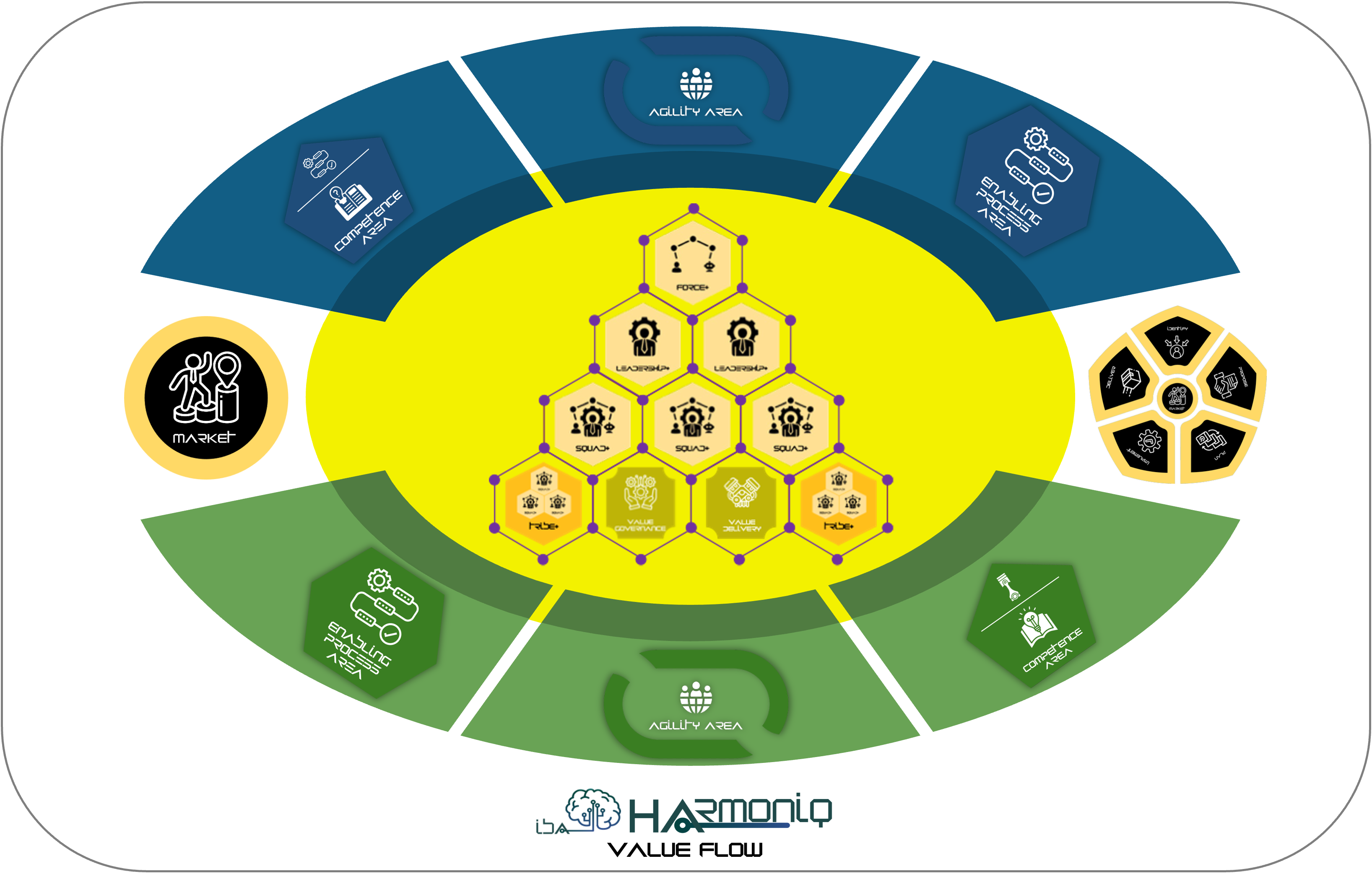
This operational level is not structured into static, permanent departments or silos. Instead, it operates as an ecosystem of "Darwinian" Micro-Enterprises, whose existence and shape are modeled solely and exclusively by the real needs of the Customer and the Market. Each Value Flow instance is born, adapts, and exists only as long as a concrete, attractive, and financially sustainable need remains. When this need changes or disappears, the flow rapidly reconfigures or disinvests.
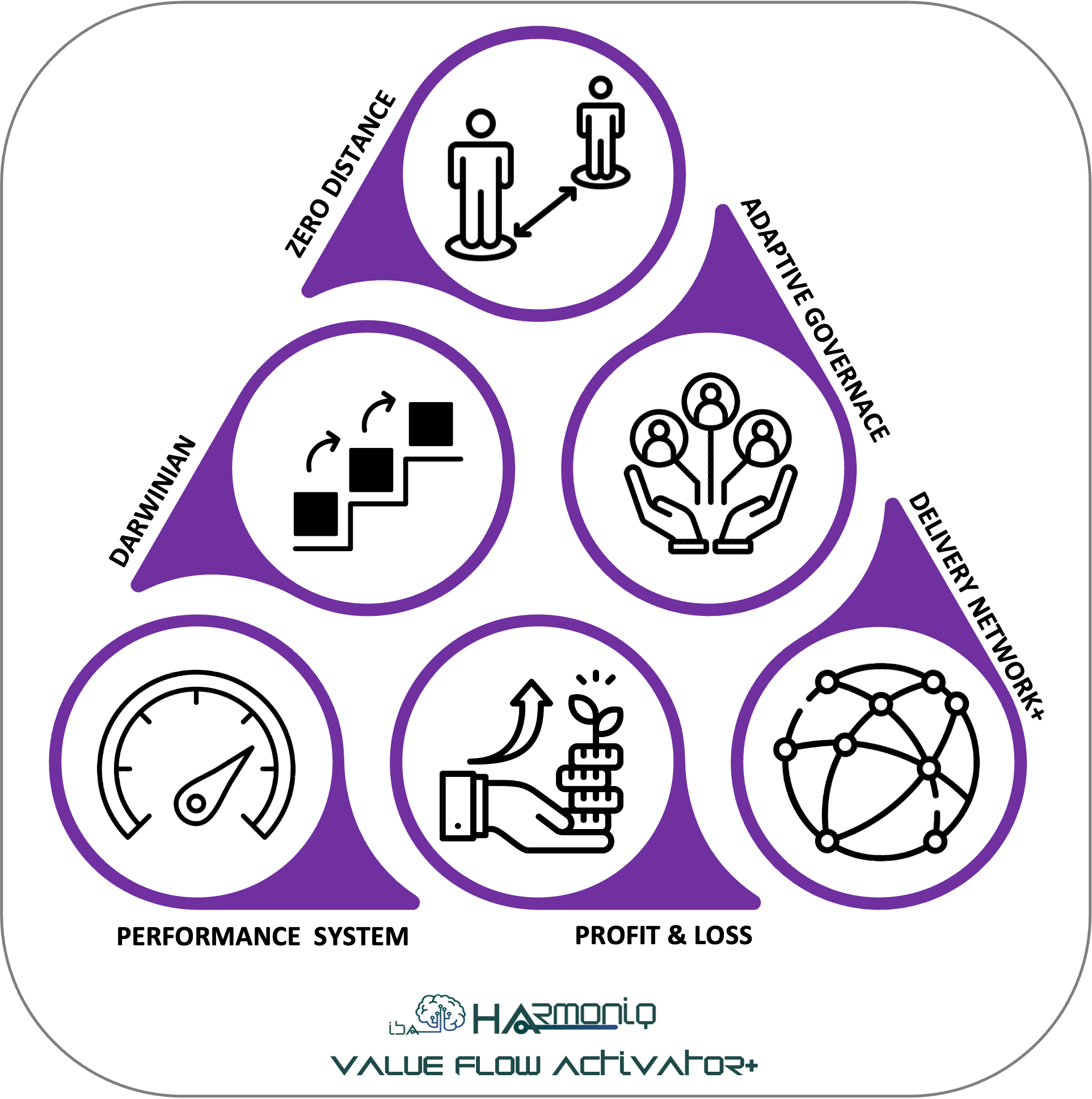
The layer is governed by the Zero Distance philosophy (inspired by the RenDanHeYi model), which eliminates any barrier between those who produce the solutions and the end-user, creating an open ecosystem that co-creates solutions. From a financial perspective, each Value Flow acts with a fully entrepreneurial logic, managing its own simulated profit and loss statement (simulated P&L) to ensure maximum sustainability.
Market: Industry + Focus Segment
The Value Flow is activated in relation to a specific Market with the aim of developing a continuous flow of Value Increments that allow you to maximize the Value generated in a Win-Win key, i.e. to the benefit of all the players involved.
The Market is defined as the combination of an Area, the competitive horizon and the technological or industrial scenario and the specific related Segment, which represents the surgical selection of customers and needs within the chosen Area:
- Ambito, answers the question: "Where do we decide to operate?"
- Industry, "Who do we decide to make a difference for?"
Value Flows are not static, but follow the evolution of the Market for which they were created.
The Value Increment (VI): the Minimum Unit of Value
To drastically reduce the risk of focusing on low-value activities or massive, abstract developments, Harmoniq adopts a strictly outcome-based approach centered on the Value Increment (VI).
The Value Increment represents the minimum release unit that contains a mix of value directly appreciable by both the customer and the organization. It has a clear anatomy that breaks down strategic initiatives into tangible results:
- Initiatives / Mission ➔ Product / Solution ➔ Value Increment ➔ Features / Deliverables.
Working in terms of value increments optimizes planning, facilitates work sequencing, and enables highly fluid and responsive resource allocation.
The Social Structure: Delivery Network+
Value Flow bases its operations on the Delivery Network+, an integrated socio-technical network that includes Human Players and AI Players organized into Squad+ (self-organized and end-to-end accountable multidisciplinary teams) and Tribe+ (multiple Squad+ aligned on complex objectives). To ensure diversity and relational balance, the Squad+ must always have at least one human guide.
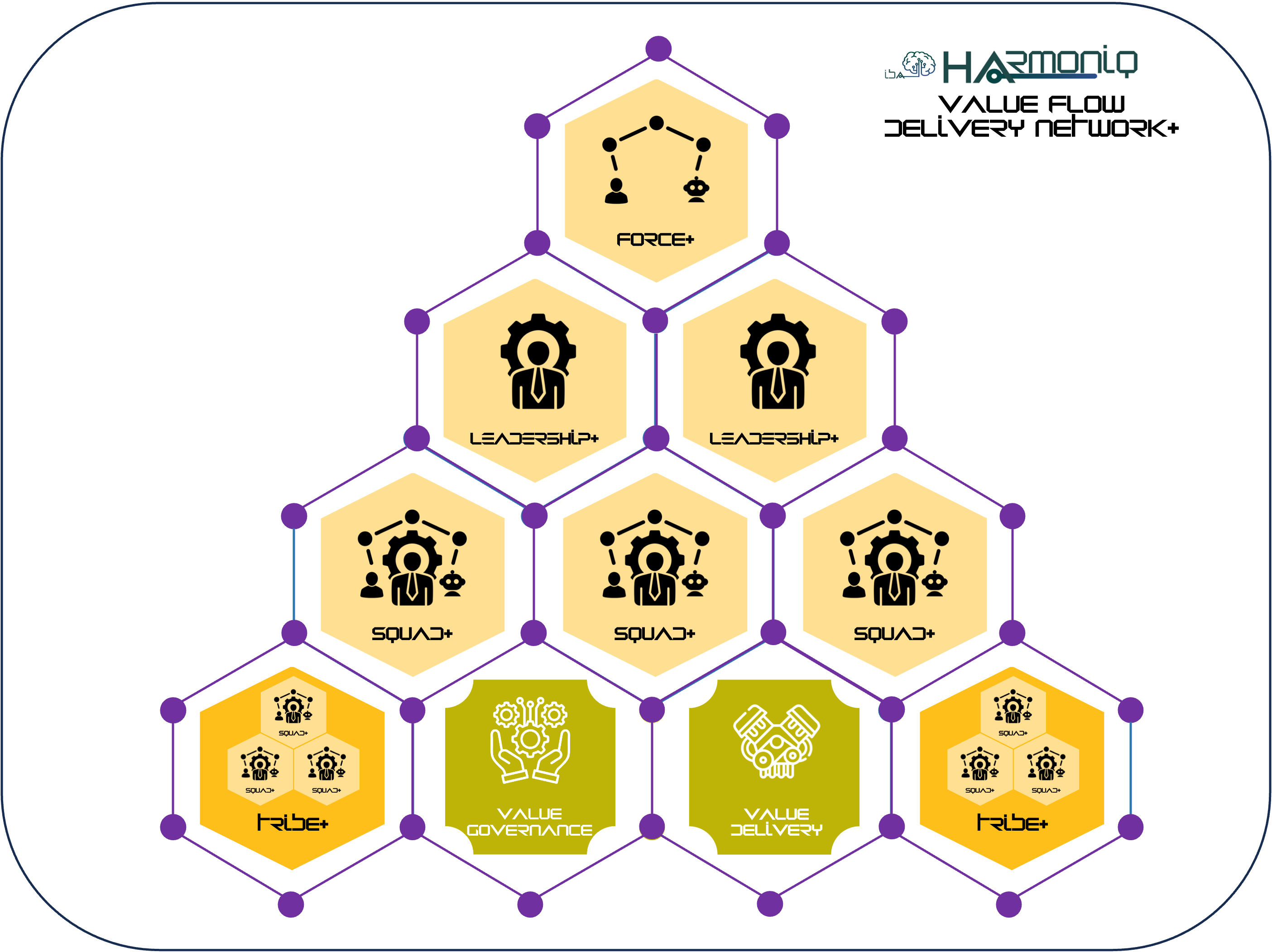
Delivery Network+
The Flow Lifecycle: the Harmoniq Value Flow Lifecycle (HVFL)
The way the company manages its markets and evolves its responses is structured into five sequential executive stages:
- Exploration: methodological study of the market context through trend analysis, external data collection, stakeholder mapping, and early detection of weak signals to understand latent needs.
- Shaping: defining the implementation strategy and value proposition. In product-oriented flows, progressive MVPs (Minimum Viable Products) are developed to rapidly test and validate hypotheses in the field.
- Takeover: the Business Growth EPA convenes the Creation Forum+, appoints the Value Manager, and assigns an initial budget to activate the Value Engine. The assignment is based on an "internal negotiation" where candidates can accept or decline the role, partly based on the associated performance and reward system.
- Evolution: the flow enters full operation, continuously releasing value. Adapting its vision based on feedback, the flow can undergo budding scenarios to split into multiple independent markets and flows.
- Ending: if the market loses its value or financial sustainability, the Business Growth area activates the Ending Forum+ to decommission the flow. The last increments currently in development are finalized and released to honor commitments. Subsequently, Human Players return to their reference EPAs/CAs for growth or new assignments, while AI Players are suspended or turned off to eliminate unnecessary infrastructure costs.
The Two Execution Flow Process Areas (FPAs)
Within each Value Flow instance, the operational balance between the "what" and the "how" is guaranteed by two temporary, instanced, and replicable process areas:
1. Value Governance FPA (The Control Room)
Guided by the Value Manager and consisting of specialists from the strategic EPAs of Proactive Enterprise, it is the direct bridge between governance and the market. It monitors critical capabilities such as Adaptive Portfolio, Predictability, Quality, and Brand Reputation.
-
- Key Capabilities: Mange Flow, Coordinates and Remove Roadblock. The three capabilities allow real-time monitoring of the status of the Value Flow, capacity planning, dependency identification and active problem solving.
- Decision-Making Autonomy: it is autonomous in rebalancing capacity between internal initiatives, handling daily operational blocks and deviations within the Value Flow's budget limits, and defining the release cadence. It is not autonomous in modifying the Purpose (requiring Strategy PA alignment), changing the budget beyond the portfolio limits, or automating work assignment via black-box AI without human supervision.
The development of the reference market takes place thanks to the Harmoniq Value Engine (HVE):
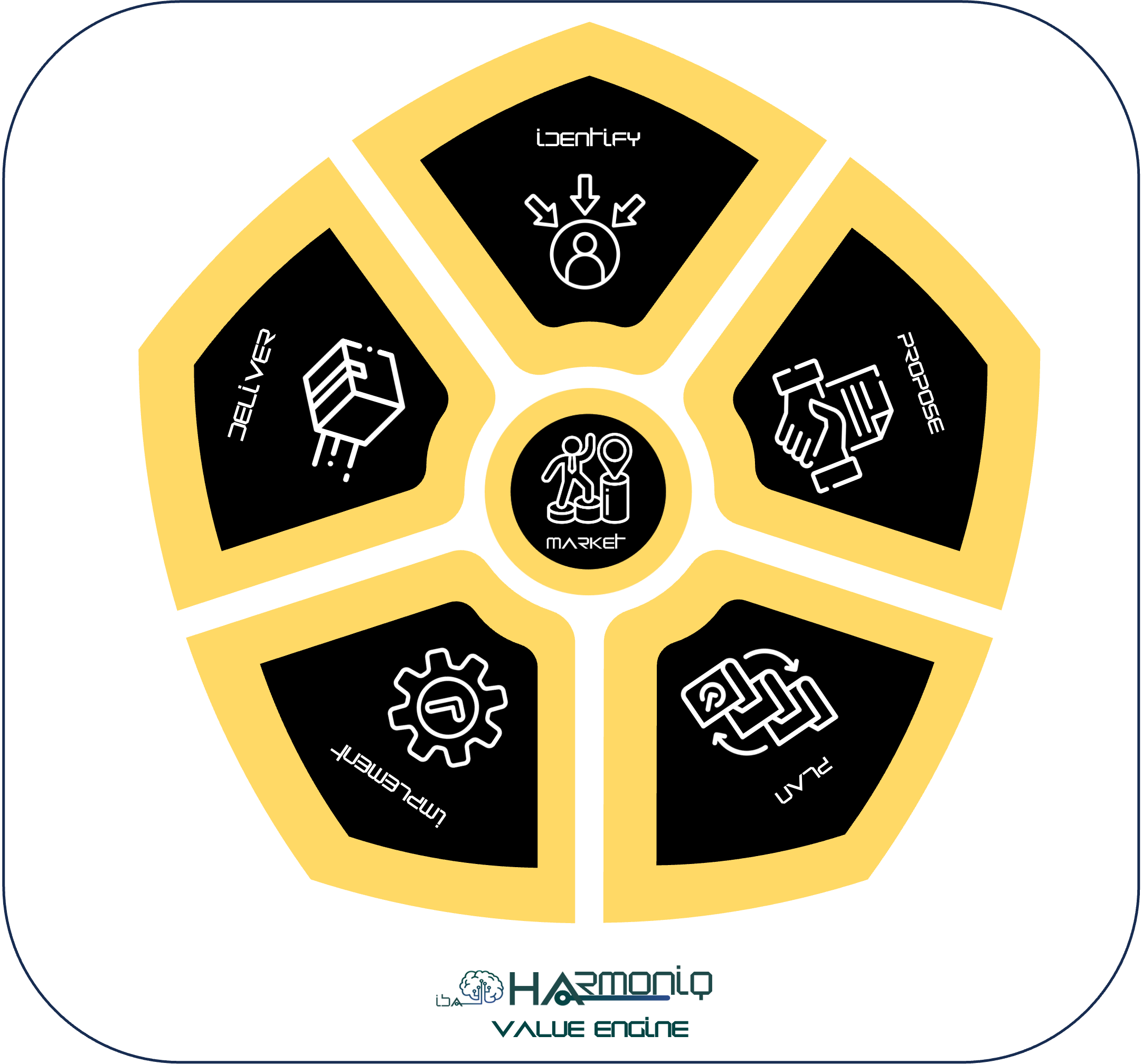 Harmoniq Value Engine
2. Value Delivery FPA (The Development Engine)
The operational orchestrator coordinating development teams up to the final adoption of the solution by the end-user. It oversees Technological Agility, focusing on the continuous release of innovative solutions.
-
-
Key Capabilities: Ensure Quality, Automate, and Enable Delivery. The three capabilities allow the development of high-quality solutions, products and answers that fully meet customer expectations.
-
Evolution Across Three Horizons: Horizon 1 (continuous release of usable, stable VIs, incident management, and change facilitation), Horizon 2 (CI/CD automation of the delivery flow to reduce costs and lead times), and Horizon 3 (anticipating user needs and collaborating with Proactive Enterprise to guide organization evolution).
-
HAI Ethics and Delivery Guardrails
In compliance with the internal AI Act (HAI Agility), the integration of agentic AI and intelligent automation within operational flows is guided by a golden rule: human supervision (human-in-the-loop) is mandatory.
It is strictly forbidden to delegate critical "Go/No-Go" release decisions or automated work assignment algorithms that negatively affect people's well-being or social capital to AI without human validation. Final validation always rests with a human player to ensure sustainability, transparency, and mutual trust.
Flow Performance Metrics
The executive effectiveness and efficiency of the Value Flow are scientifically measured using impact indicators across horizons:
- Value Increment Release Frequency (Horizon 1): the number of Value Increments released and validated by stakeholders.
- Operational Resiliency MTTR (Horizon 1): effectiveness in resolving incidents and malfunctions in real-world environments.
- User Adoption Rate (Horizon 1): the success rate in user adoption of the new released solutions.
Without human intelligence, there is no utility or purpose for artificial intelligence