CAPABILITY PILLAR
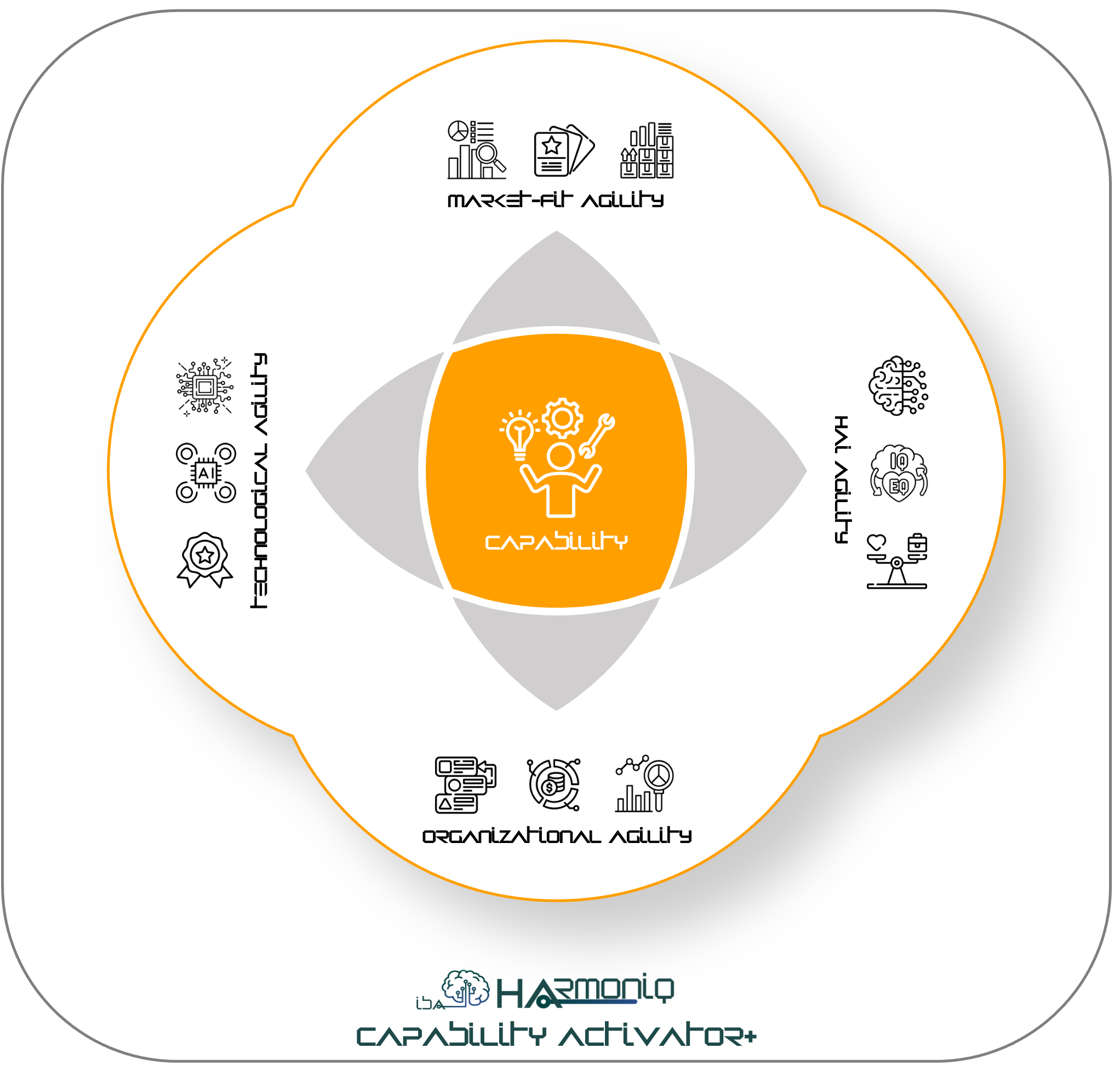
In the Harmoniq operating model, true business agility is not measured only by the speed of decisions, but by the robustness and flexibility of its organizational "muscles": the Capabilities. They represent the essential capabilities needed to guide and orient the organization through uncertainty, ensuring that the entire company can move in a coordinated, efficient, and proactive way.
Harmoniq's Capabilities are characterized by three fundamental properties:
- Transversality: developing capabilities common to the entire organization and at the service of different strategic activities.
- Designation: highlighting which Process Areas primarily impact the different capabilities.
- Performance: clarifying how capabilities are measured and what the minimum acceptable performance levels are.
The identification of capabilities is the task of the Agility Areas, which monitor their performance and strategic value in relation to strategy.
The Activators+: The 4 Systemic Dimensions
To structure and evolve these capabilities in a coherent way, Harmoniq's capabilities are grouped into four macro-systemic dimensions of Intelligent Business Agility, called Capability Activator+.
1. HAI Agility Activator+: Socio-Technical Symbiosis
HAI Agility oversees the organization's capability to balance the integration of the human component and artificial intelligence, evolving leadership, relational sensitivity, and advanced technology use. It is composed of three complementary capabilities that guide more conscious decisions, more effective relationships, and high-value automation:
-
- Smart Leadership: Smart Leadership does not see diversity and AI as a threat, but as enablers to focus on higher value-added activities, including strategic vision and critical supervision. It develops through:
- Data-driven decisions: leaders rely on concrete data and insights to guide strategic choices, reducing uncertainty and increasing decision effectiveness.
- Change management: accompanying the organization in the transition to a Human-AI collaboration model, reducing resistance and encouraging adoption.
- Favorable organizational culture: building a work environment that values the integration between people and technology, laying the foundations for lasting AI adoption.
- Emotional Intelligence: Emotional Intelligence focuses on improving the understanding and management of emotions, both internally (collaborators) and externally (customers). It fosters emotional resilience and empathy, improving the overall experience of the people involved in the organization. It is articulated in:
- Understanding emotions: developing emotional awareness at individual and team levels, to face daily challenges with greater clarity.
- Emotional resilience: strengthening the capacity to adapt and react positively to stress and change situations.
- Empathy toward customers and collaborators: improving internal and external relationships, elevating the overall experience of the people involved.
- Artificial Intelligence: it implements advanced AI models, as well as specific Agents, to support automation, predictive analysis, and continuous improvement, maximizing data value to drive faster and more accurate decisions. It focuses on:
- Advanced models and Agents: introducing intelligent solutions capable of operating with autonomy on specific and repetitive activities.
- Automation and predictive analysis: reducing operational load and anticipating future scenarios thanks to advanced data processing.
- Data value for rapid decisions: transforming data into actionable insights, accelerating and improving decision quality.
- Smart Leadership: Smart Leadership does not see diversity and AI as a threat, but as enablers to focus on higher value-added activities, including strategic vision and critical supervision. It develops through:
2. Market-Fit Agility Activator+: Market Reading and Response
Market-Fit Agility represents the capability to read the market, interpret its signals, and translate them into relevant and distinctive responses. The annexed capabilities are: Market Discovery, Brand Reputation, and Innovative Solutions, allowing the definition of how the organization can anticipate needs, strengthen positioning, and generate value-oriented innovation.
-
- Market Discovery: Market Discovery is the action of real-time market analysis, identifying emerging trends and unserved segments. It is the starting point for building effective strategies based on concrete data. It focuses on:
- Real-time market analysis: constantly monitoring the evolution of the competitive context to avoid being caught unprepared.
- Emerging trends: early detection of signals of change to anticipate competitors.
- Unserved segments: discovering new market opportunities on which to build a lasting competitive advantage.
- Brand Reputation: Brand Reputation emphasizes how a strong brand not only retains current customers but attracts new ones and makes the organization a leader in its sector. The related action develops through monitoring, sentiment analysis, and targeted communication strategies. It focuses on:
- Perception monitoring: keeping under control how customers and stakeholders perceive the organization, the products, and services offered.
- Retention and attraction: a strong brand consolidates the relationship with existing customers and wins new ones.
- Sentiment analysis and targeted communication: using digital tools to intercept public opinion and build effective messages.
- Innovative Solutions: Innovative Solutions allow the organization to develop responses that anticipate and satisfy new market needs, transforming innovation into a lasting competitive advantage. It focuses on:
- Anticipate market needs: developing products and services before demand fully solidifies.
- Satisfy new needs: responding with targeted solutions to emerging customer and market needs.
- Continuous innovation: making innovation a structured and repeatable process, not an occasional event.
- Market Discovery: Market Discovery is the action of real-time market analysis, identifying emerging trends and unserved segments. It is the starting point for building effective strategies based on concrete data. It focuses on:
3. Organizational Agility Activator+: Structural Flexibility and Resilience
Organizational Agility enables the organization to adapt structures, priorities, and decision-making mechanisms based on context changes and strategic objectives. The annexed capabilities are: Adaptive Portfolio, Dynamic Budgeting, and Predictability, three capabilities that make a more resilient, flexible, and governable setup possible.
-
- Adaptive Portfolio: Adaptive Portfolio makes organizations resilient and proactive in a market characterized by volatility and uncertainty. It allows continuously realigning corporate priorities, directing resource allocation toward initiatives that guarantee the highest strategic and economic return. It focuses on:
- Resilience in volatile markets: adapting rapidly to uncertain and continuously changing market conditions.
- Continuous realignment of priorities: constantly reviewing corporate goals based on context and new information.
- Resource allocation on maximum return: directing investments and resources toward initiatives with the highest strategic and economic value.
- Dynamic Budgeting: Dynamic Budgeting overcomes the rigidity of traditional budgeting processes. It allows a continuous and iterative allocation of financial resources, in line with strategic goals and market changes. It focuses on:
- Overcoming traditional rigidity: abandoning static and inflexible planning cycles in favor of a dynamic approach.
- Continuous and iterative allocation: periodically reviewing financial resource distribution based on results.
- Alignment to goals and market: ensuring coherence between budget, corporate strategy, and evolving external conditions.
- Predictability: Reliable Predictability guarantees stability and operational success in a complex context. Thanks to it, organizations can anticipate trends, prevent inefficiencies, and reduce operational uncertainty, improving result stability. It focuses on:
- Anticipation of trends: identifying in advance the dynamics that will influence the business in the short and medium term.
- Prevention of inefficiencies: intervening before problems concretely manifest, reducing correction costs.
- Result stability: ensuring performance continuity and reliability even in uncertain contexts.
- Adaptive Portfolio: Adaptive Portfolio makes organizations resilient and proactive in a market characterized by volatility and uncertainty. It allows continuously realigning corporate priorities, directing resource allocation toward initiatives that guarantee the highest strategic and economic return. It focuses on:
4. Technological Agility Activator+: The Balanced Technological Heritage
Technological Agility expresses the capability to govern the technological heritage with a balanced approach between optimizing the existing, adopting innovation, and presiding over quality. The annexed capabilities are: Established Technologies, Edge Technologies, and Quality, which combine to build operational efficiency, competitive advantage, and reliability over time.
-
- Established Technologies: robust use of Established Technologies allows improving efficiency and reducing costs without interrupting critical processes, ensuring efficient use of existing solutions and their integration with new systems. It focuses on:
- Efficiency and cost reduction: optimizing the use of existing technologies without interrupting critical activities.
- Critical process continuity: ensuring that optimization does not compromise the organization's key operations.
- Integration with new systems: ensuring compatibility and synergy between consolidated technologies and new solutions.
- Edge Technologies: the use of Edge Technologies, i.e., cutting-edge solutions like artificial intelligence, blockchain, and edge computing, prepares the organization for the near future. It involves promoting gradual and strategic adoption to generate competitive advantages and anticipate competitors. It focuses on:
- Cutting-edge solutions: adopting AI, blockchain, and edge computing to explore new technological frontiers.
- Gradual and strategic adoption: introducing innovation with a measured approach, reducing implementation risks.
- Competitive advantage: anticipating the market with solutions competitors have not yet adopted.
- Quality: it focuses on implementing processes and tools that allow guaranteeing high standards of quality, security, and regulatory compliance. Automation and predictive systems are fundamental to reducing errors and increasing reliability. It focuses on:
- High standards of quality and security: guaranteeing products and services compliant with regulations and customer expectations.
- Automation and predictive systems: reducing errors thanks to tools that monitor and anticipate operational criticalities.
- Reliability over time: building trust with customers and stakeholders through constant and verifiable quality.
- Established Technologies: robust use of Established Technologies allows improving efficiency and reducing costs without interrupting critical processes, ensuring efficient use of existing solutions and their integration with new systems. It focuses on:
Without human intelligence, there is no utility or purpose for artificial intelligence