ARCHITECTURAL BLUEPRINT PILLAR
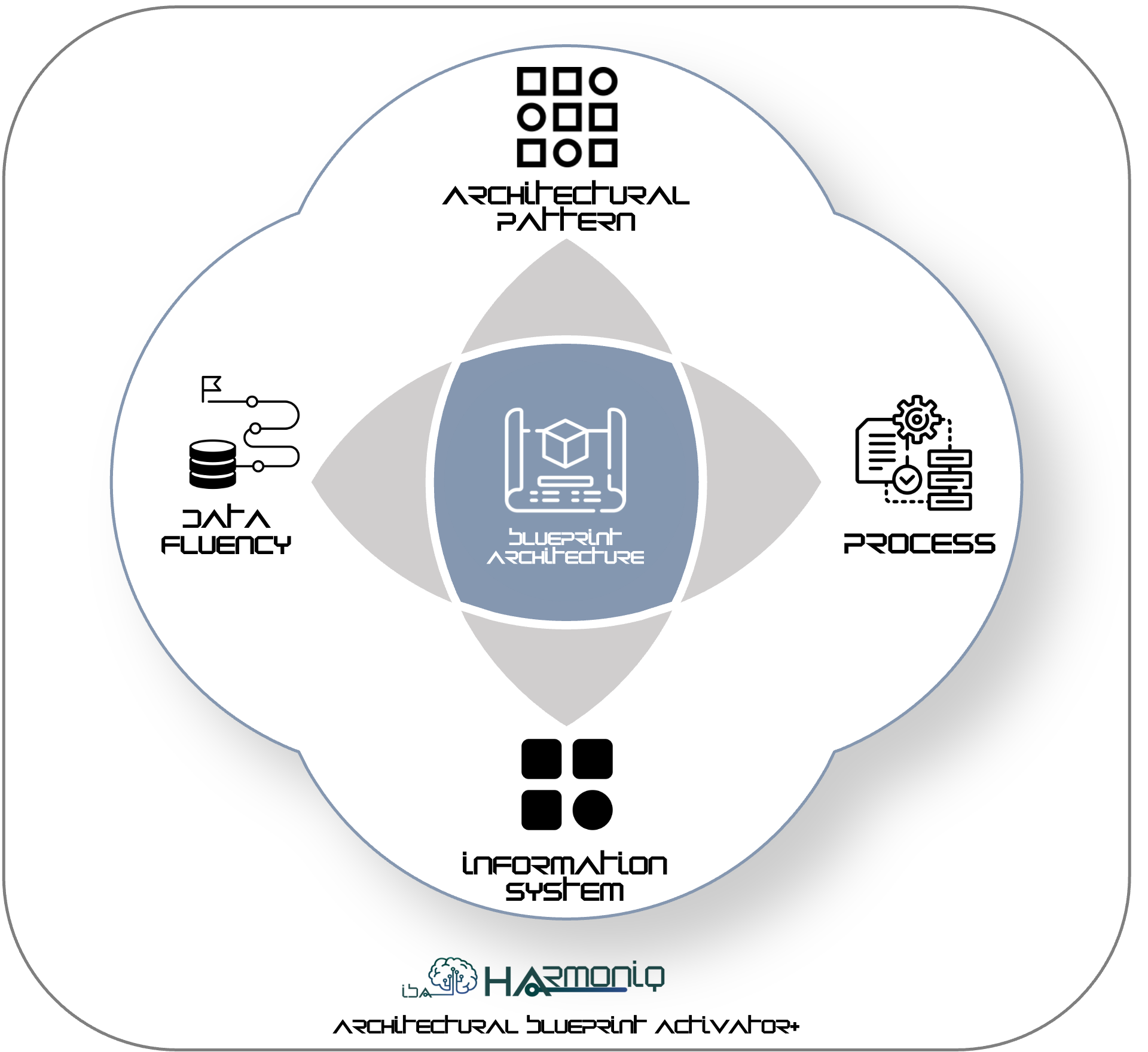
Within the Harmoniq organizational model, the Architectural Blueprint develops the aspects of Enterprise Architecture (EA) by declining them in a Lean-Agile key to govern and actively support the positive tension between scaling and agility. Coordinated by the Transformation PA, the Architectural Blueprint is explicitly People & Value Centric: it builds the enterprise architecture on roles, capabilities, and real talents, integrating co-creation and local empowerment.
Enterprise Architecture is not experienced as a "simple IT initiative", but as an ongoing organizational action that allows observing data and platforms from an organizational perspective and helping the various process areas achieve their objectives efficiently. It focuses on the alignment between business goals and the operational, informational, and technological structure through four major domains and two transversal pillars:
- The Four Domains of Enterprise Architecture
- Business: defines the structure and behavior of business functions, aligning strategies, people, processes, and business goals.
- Data: describes the types of data used to support the business, the models applied, and the characteristics of data flows both "at rest" and "in motion".
- Application: catalogues all digital applications and describes their work in transforming, transmitting, and storing information, documenting interfaces and interaction modes.
- Technology: represents the technological platforms, hardware, networks, and physical or virtual infrastructures that sustain the execution of the systems.
- The Two Transversal Pillars (Pillars)
- Governance: comprises leadership, organizational structures, and processes that ensure the consistency of investments with business goals, providing oversight and strategic direction. It is based on a Lean Governance that abandons document-based policing to make compliance (e.g., GDPR) the easiest and most efficient way, enabling rather than blocking teams through radical visibility of real-time dashboards.
- Standards: defines the set of mandatory rules, techniques, processes, and models to guarantee compatibility, operational quality, and interoperability between components. It establishes a Shared Vocabulary (common ontologies and taxonomies) to ensure that business and IT speak the same language.
The Four Architectural Blueprint Activators+
1. Architectural Pattern: Pattern Library and Pattern Language
Patterns allow customising Harmoniq's dynamics to the specificity of the organization and accompanying its evolution. They provide ready-to-use and reusable solutions to recurring design problems:
-
- Pattern Library (Architectural Layer): a collection of ready-to-use solutions, described as a "DIY toolkit" (Do It Yourself). In Harmoniq, the individual layers (Foundation, Proactive Enterprise, Adaptive Design, Value Flow) realize this library.
- Pattern Language (Decision-Making Grammar): a holistic and choreographed system where patterns are not only present but are interconnected by precise relationships and grammatical rules to solve complex problems. It defines the ways in which the different constituent elements of the layers combine and collaborate with each other.
In the model, the Process Areas (EPA/FPA), Competence Areas (CA), and Agility Areas (AA) constitute the fundamental patterns with which Harmoniq manages scaling and actively supports the positive tension Scaling/Agility:
-
- Enabling Process Area (EPA): stable, consolidated, and unique structures that offer transversal services ("cross") and support organizational efficiency (e.g., People, Transformation, Finance). Iconographically represented by a Hexagon.
- Flow Process Area (FPA): temporary structures, duplicated 1:1 with respect to the Value Flows, focused on developing a specific Market at "Zero Distance" from the customer (e.g., Value Governance, Value Delivery). Iconographically represented by a Shield/Plate.
- Competence Area (CA): fluid and specialized structures internal only to the Enabling Process Areas, responsible for providing vertical services through dynamic Squads+ formed by highly qualified talents.
- Agility Area (AA): unstructured aggregators that directly correlate specific EPAs to ensure that the strategy does not remain abstract but flows into the three agility dimensions of IBA: market, organization, and technology.
2. Processes: unleashing the Value of Widespread Delegation
Processes define the correct perimeters of action to unleash the value of widespread delegation. In Harmoniq, the fundamental mantra is only one: «the only useful process is the one that is not felt»; meaning that processes must never block the activities and actions of players, and that when this happens, it is a symptom that something needs to change. They are divided into two large families:
-
- Core Processes: "end-to-end" processes that flow horizontally through multiple EPAs, where the output of one area is the critical input for another. Their definition sees a process ownership defined in relation to the transversality of each process:
- Core Process M80-S20: processes whose ownership falls 80% on a Master PA, and 20% on a minimal set (or one) of Slave PAs. Transformation assumes the role of integrator and validator with respect to the Architectural Blueprint.
- Core Process M50-S50: processes where ownership falls 50% on a Master PA, and the remaining 50% on a minimal set (or one) of Slave PAs. Transformation assumes a facilitator role to enable dialogue between the connected PAs.
- Core Process M20-S80: processes with a practically equal distribution of responsibility among different PAs. Transformation assumes an active designer role.
- Core Processes: "end-to-end" processes that flow horizontally through multiple EPAs, where the output of one area is the critical input for another. Their definition sees a process ownership defined in relation to the transversality of each process:
-
- Local Processes: vertical processes predominantly pertaining to and managed internally within a single specific Process Area of relevance (e.g., the specific local processes of Transformation, People, Digital Governance, Business Growth, and Viability). Transformation can provide methodological support for the definition and assumes the role of integrator and validator with respect to the blueprint.
Quality Evaluation: the Process Definition of Done (P-DoD)
To objectively evaluate processes, Harmoniq uses a Process DoD (P-DoD) that must satisfy the following four qualitative pillars:
- Architectural and Documental Integrity (Integrity): the process must have a transparent and mapped structure (SIPOC, clear triggers and conclusions, and an identified Process Owner).
- Alignment to Value (Value Fulfillment): it must demonstrate concrete value by adopting Acceptance Criteria (AC) and the "bare minimum" of execution steps to generate the desired outcome, eliminating redundancies or bottlenecks.
- Human + AI Integration (AI-First Ready): mapping where AI can accelerate routine, automate tasks, or support decisions, ensuring structured, validated, and accessible data (Data Readiness), and defining mandatory human-in-the-loop supervision points for critical or ethical choices.
- Consciousness and Control (Consciousness & Compliance): the process must be secure, ethical, and constantly monitored through real-time KPIs (e.g., Time-to-Value, Throughput), risk management guardrails, and constant learning and improvement cycles (PDCA/Retrospective).
Two Key Core Processes: Strategic Planning and Fast Experimentation
-
- Vision-to-Implementation Management (Strategic and Operational Planning): an end-to-end process that translates Mission and Vision into execution. A distinctive element is the integration of the "Theory of Constraints" (TOC) into strategic thinking: systematically identifying "undesirable effects" and transforming them into "intermediate objectives" to overcome operational bottlenecks that prevent growth.
- Fast Experimentation (Innovation and Knowledge): a lean process that enables fast, low-risk innovation experiments within the organization, operating in a total regime of Self-governance. It moves through a structured cycle:
- Inspiration: gathering insights, intuitions, and ideas in an "Innovation Backlog" for experimentation.
- Execution: a corporate Player steps forward to take charge of an experiment, becoming the Experiment Owner (acting as a Mission Leader). If necessary, they compose the ideal Innovation Squad+ (hybrid Human & AI Player) leveraging widespread delegation and a total "Zero Signature" approach. The experiment operates under rapid 1-Week Slicing cycles to build Proof of Concepts (PoC) or MVPs.
- Promotion: final evaluation based on the DFS triad (Desiderability, Feasibility, Sustainability). The Decision Gate can lead to: Archive (not desirable or sustainable), Pause (valid but lacks surrounding conditions), Pivot (the need persists, but the tested solution is wrong - reformulate hypothesis), or Build/Scale (full success - the initiative enters systemic development, structural EPA initiatives, Transformation actions, Discovery, or officially enters the Harmoniq Delivery Engine (HDE)).
- Innovation Guardrails: the framework imposes strict rules, including "Safe-to-fail" (protected experimentation), "No-Blame" (psychological safety), prohibition of keeping "Zombie Projects", and clear care of the Sunk Cost Fallacy. At the end of every one-week iteration, results are shared with the rest of the corporate ecosystem (Pollination) via the Ambassador Network+.
3. Information System: the Digital Spine of the Organization
Information System Management governs the evolution of the company's integrated information system to allow each function to perform its tasks with speed and precision. A modern Information System must always be integrated, serving as a single source of truth (Single Version of Facts or Single Source of Truth) to eliminate information fragmentation and systematically elevate data literacy across the entire organization.
4. Data Fluency: understanding and Working with Data
Data Fluency is the ability to understand, interpret, work with, communicate, and make data-driven decisions at all corporate levels. Harmoniq treats data architecture not as a rigid infrastructure, but as a dynamic product to be funded and governed to quickly adapt in a BANI (Brittle, Anxious, Non-linear, Incomprehensible) context.
The Technological Heart: Data Vault 2.0 and DataOps
Unlike rigid and traditional star or snowflake schemas, Harmoniq adopts the Data Vault 2.0 (DV2) architecture, designed for scalability, auditability, and extreme flexibility to change. It is based on three separate core components:
-
- Hub: central business concepts (e.g., Customer, Product).
- Link: relationships between entities.
- Satellite: descriptive attributes and historical context over time.
This design allows adding new data sources (new Hubs or Links) without destroying existing processes and guaranteeing an integrated end-to-end Data Lineage.
The approach is strictly Usage-Driven (guided by usage requirements rather than mere data accumulation) and translates into:
-
- Question Stories: what does the business need to know?
- AI Stories: what does the intelligent model need to predict?
- JBGE (Just Barely Good Enough): designing solutions that are "sufficient, not perfect" to dismantle bureaucracy.
- DataOps Automation: brings the DevOps culture to the data world, enabling automated schema testing and changes (Continuous Database Integration - CDI) and fluid, zero-risk releases (Continuous Database Deployment - CDD).
Without human intelligence, there is no utility or purpose for artificial intelligence