ENTERPRISE ROLE PILLAR
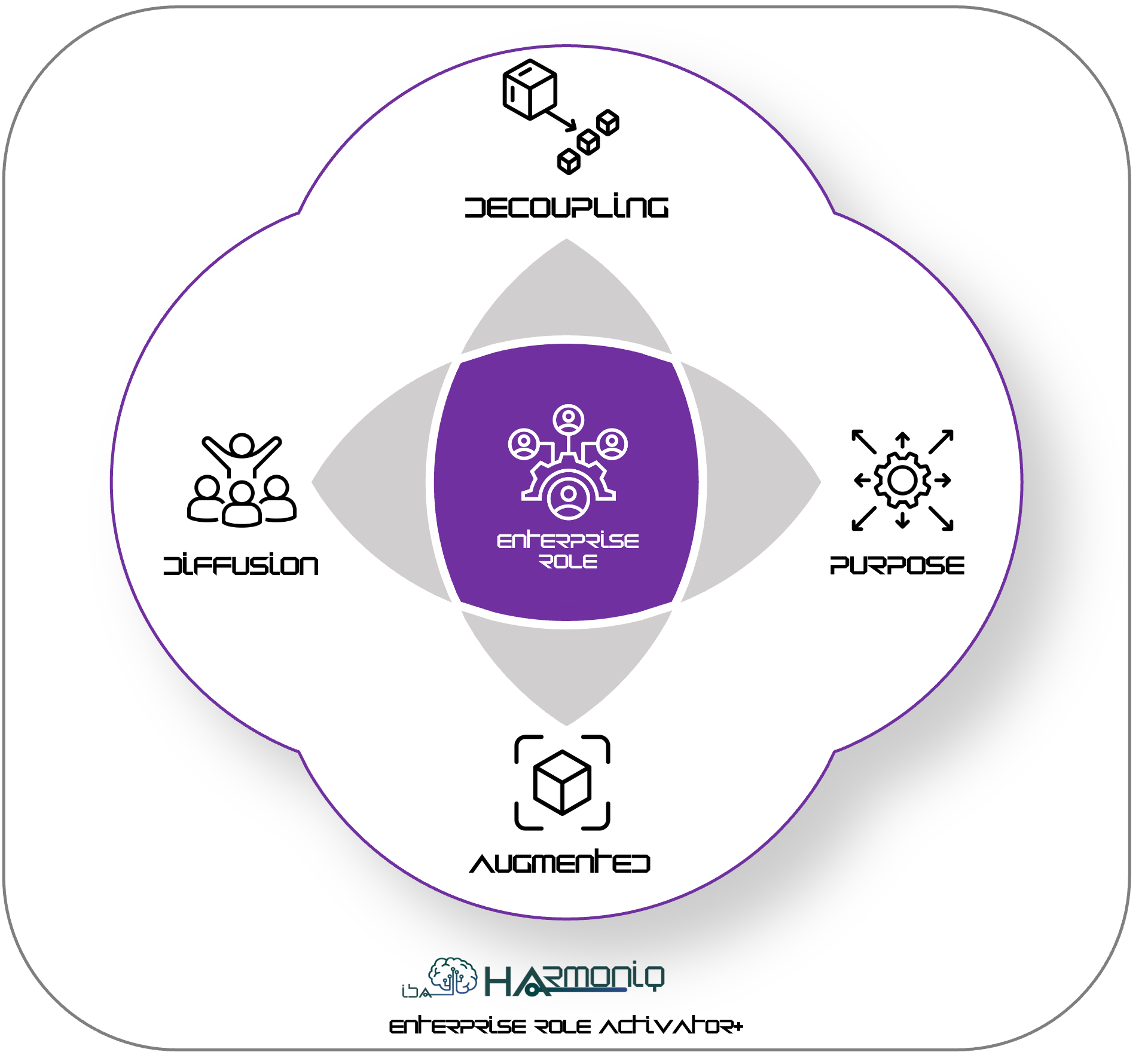
Within the Harmoniq operating model, Enterprise Roles completely redefine how the organization maps and distributes responsibilities. Moving away from old and rigid static job descriptions is the first step to eliminate conflicts, overlaps, and operational inefficiencies, ensuring:
- Clarity of responsibilities: precisely defining what is expected from each role, reducing ambiguity, conflicts, and overlaps to improve operational efficiency and resource allocation.
- Strategic alignment: aligning individual roles to overall business goals, facilitating cross-functional collaboration and supporting strategy execution.
- Scalability and Governance: enabling organizational growth through calibrated delegation, access management, and process optimization, ensuring resilience and adaptability to changes.
The development, maintenance, and evolution of this roles framework are entirely entrusted to the Transformation and People Enabling Process Areas (EPAs), which guarantee their organizational, contractual, and professional alignment.
The 4 Enterprise Role Activators+
Harmoniq's role design model transforms the organization from a hierarchy of power to an "Organizational Galaxy" based on the stratification of purposes, where roles are the fundamental connector between strategy, human talent, and artificial intelligence. It develops through four operational reference activators (Enterprise Role Activators+):
1. Decoupling: Radical Separation of Person and Role
Person and Role are radically separated to eliminate the historical limitations of the associated personalization. Harmoniq ceases to consider the role as a hierarchical position, transforming it into a dynamic entity endowed with a Purpose, clear Accountability, and Domains of authority. This distinction allows the organization to be "liquid": people can "energize" multiple roles simultaneously, moving to where their talent generates the most value.
2. Purpose: balancing Efficiency and Dynamism
The goal is to balance Efficiency and Dynamism, ensuring that each role knows whether its goal is to enable others or directly serve the market. Roles are organized by Purpose, and not by Power, clearly defining their nature in function of their declination. Roles are divided into:
-
- Stable and unique roles: focused on maximizing efficiency and technical expertise, energized mainly within Enabling Process Areas (EPAs) and Competence Areas (CAs).
- Dynamic and replicable roles: orchestrating the flow of value toward the customer, energized mainly within Flow Process Areas (FPAs) and Value Streams.
3. Augmented: Integration of AI Players
The role evolves into an Augmented Role, capable of processing data in real time, enabling Agility. Harmoniq introduces a fundamental distinction between Human Players (people) and AI Players (AI or digital assistants in general): roles are designed to be filled in total synergy by both, where AI automatizes repetitive tasks and the human focuses on creativity and critical supervision. The goal is to transform accountability from individual to widespread, enhancing the role's decision-making capacity through real-time data.
-
- Key Ethical Guardrail: Leadership roles are the exclusive preserve of Human Players.
4. Diffusion: Smart Leadership and Entrepreneurship
The clear definition of roles enables Smart Leadership and Entrepreneurship, developing the essential competencies to govern the complex challenges of modern organizations. Harmoniq defines specific leadership roles that do not command people, but harmonize relationships. This is done to ensure that local autonomy does not turn into chaos, but remains aligned with the global strategy through a "partnership of intent" guided by the reference Guardrails.
Key Roles Map in Harmoniq
The success of the Operating Model relies on the perfect functioning and respect for the specific accountability of the ecosystem's key roles:
Corporate Governance
-
- CEO (Chief Executive Officer): the top manager in charge of business management. Their main task is to define the global strategy of the enterprise and ensure that growth and profit objectives are met, guiding the various executives.
- Board Member: a member of the Board of Directors (CdA), counselor, or director. A key figure in corporate Governance with responsibilities in defining strategic goals and directing the company, monitoring management and executives, and key decisions.
- Shareholders: the owners of one or more shares of a company. Their role is primarily economic, aimed at protecting and growing the capital invested in the enterprise.
Enabling & Competence Structure
-
- Head of Enabling Process Area (Head of EPA): guides operational excellence and the vision of the process area, structuring it to provide the necessary services to achieve company goals.
- Accountabilities: define and implement the vision and structure of their EPA; develop the EPA's Players, in symbiosis with CAs; ensure the diffusion of culture and domain practices throughout the company; manage the EPA's budget; handle administrative aspects (leaves, approvals, etc.); coordinate Heads of CA and Players of the EPA; support training needs collection, certifications, and knowledge-sharing; facilitate the evolution and innovation of internal Ways of Working; contribute to defining and implementing corporate strategy.
- Head of Enabling Process Area (Head of EPA): guides operational excellence and the vision of the process area, structuring it to provide the necessary services to achieve company goals.
-
- Head of Competence Area (Head of CA): fosters the development of competencies and domain assets, functional to goals and strategic horizons.
-
-
- Accountabilities: Define the competencies and tools needed to provide talented Players and tools to enable Value Flows in their operations; develop pre-sales actions; collaborate with the Operations EPA to ensure alignment with business goals; support members' professional growth and career through training, coaching, etc.; facilitate knowledge-sharing among CA members and other CAs; monitor members' performance and well-being, identifying improvement opportunities; promote innovation and technological experimentation in their domain.
-
Value & Delivery Direction
-
- Value Manager: governs the continuous generation of Value, reacting and, where possible, anticipating market/customer needs with a prompt and effective response.
- Accountabilities: holds the ultimate decision on all Value Flow choices relative to the Market; ensures the Value Flow continuously generates Value (Value Increment) in synergy with the reference market/customer; guides the coordination Forum+ among and with Mission Leaders and Initiative Leaders; manages the simulated P&L associated with the Value Flow; manages the Value Flow, coordinating its Forum+ and decision dynamics; collaborates actively and synergistically with the Delivery Manager to ensure consistency between needs, design, and operations; promotes a proactive culture within the Value Flow; collaborates with the Revenue Operations federation for strategic direction.
- Accountabilities: holds the ultimate decision on all Value Flow choices relative to the Market; ensures the Value Flow continuously generates Value (Value Increment) in synergy with the reference market/customer; guides the coordination Forum+ among and with Mission Leaders and Initiative Leaders; manages the simulated P&L associated with the Value Flow; manages the Value Flow, coordinating its Forum+ and decision dynamics; collaborates actively and synergistically with the Delivery Manager to ensure consistency between needs, design, and operations; promotes a proactive culture within the Value Flow; collaborates with the Revenue Operations federation for strategic direction.
- Value Manager: governs the continuous generation of Value, reacting and, where possible, anticipating market/customer needs with a prompt and effective response.
-
- Delivery Manager: guarantees quality, coherence, and consistency of delivery, ensuring an efficient response to the reference market/customer needs.
- Accountabilities: Holds the ultimate decision on delivery modes, but responds to the Value Manager for the adequate response to market needs; coordinates overall delivery activity of the Value Flow, guiding the Forum+ with Technical Leaders and Technical Directors; collaborates actively and synergistically with the Value Manager to ensure consistency between needs, design, and operations; monitors allocations, interdependencies, and capacity/competency needs, identifying optimization opportunities; provides "field" feedback to EPAs and CAs.
- Accountabilities: Holds the ultimate decision on delivery modes, but responds to the Value Manager for the adequate response to market needs; coordinates overall delivery activity of the Value Flow, guiding the Forum+ with Technical Leaders and Technical Directors; collaborates actively and synergistically with the Value Manager to ensure consistency between needs, design, and operations; monitors allocations, interdependencies, and capacity/competency needs, identifying optimization opportunities; provides "field" feedback to EPAs and CAs.
- Delivery Manager: guarantees quality, coherence, and consistency of delivery, ensuring an efficient response to the reference market/customer needs.
Horizontal Connectors
-
- Federator: develops a two-way connection between strategy and operational direction, coordinating the necessary operational response of the various EPAs.
- Accountabilities: Brings the "voice" of the organization into the Strategy Forum+ and the voice of direction into Federation Forum+; integrates organizational and operational evolution to enable overall adaptability; promotes a proactive and resilient culture; proactively monitors the evolution of organizational/operational aspects, intervening with targeted experiments for pivoting and optimization; promotes a proactive, AI-First culture of Operations Excellence, optimization, and continuous innovation; uses what-if modeling for evolutionary de-risking.
- Ambassador: facilitates the development of corporate Climate and Culture at all levels.
- Accountabilities: Knows the Organizational and Operating Model in depth; diffuses model aspects, helping implement local Minimum Viable Changes before they are scaled globally; develops local stimulation and improvement actions for specific EPAs and CAs, systematically gathering feedback; participates in the Ambassador Forum+ to define, update, and implement the Ambassador Backlog; participates, when useful, in the Evolutionary Forum+ to feed the WoW Evolutionary Backlog.
- Federator: develops a two-way connection between strategy and operational direction, coordinating the necessary operational response of the various EPAs.
Execution on the Ground (Squad+ and Tribe+)
-
- Human & AI Players: develop deliverables and solution activities, generating the outcomes expected by the Mission. An AI Player is considered a technical support or a virtual collaborator (e.g., predictive analytics, code writing, automated testing, decision support, backlog prioritization).
- Accountabilities: Use the most effective and efficient technical-technological solutions; guarantee high quality of what is built; develop Human-AI collaboration for collective super-intelligence; support Squad+ Leadership+ in decisions; suggest innovations and share experiences with reference CAs.
- Mission Leader (Squad+ Leadership+): guarantees that Squad+ activities are functional to achieving the specific Mission objectives.
- Accountabilities: Contributes to defining the mission vision and implementation roadmap; clarifies mission objectives and business context when necessary; participates in alignment and coordination Value Flow Forum+; manages workflow, reducing waste and impediments; promotes a transparent, stimulating, and sustainable work environment; monitors Squad+ Health.
- Human & AI Players: develop deliverables and solution activities, generating the outcomes expected by the Mission. An AI Player is considered a technical support or a virtual collaborator (e.g., predictive analytics, code writing, automated testing, decision support, backlog prioritization).
-
- Technical Leader (Squad+ Leadership+): guarantees technical quality and reliability of solutions.
- Accountabilities: Defines the backlog of deliverables and activities supporting the Mission; participates in alignment and coordination Value Flow Forum+; coordinates workflow, reducing waste and removing impediments; defines and maintains quality standards, facilitating associated choices; promotes AI Player and AI use where possible; collaborates with CAs to align best practices and provide direct "field" feedback.
- Accountabilities: Defines the backlog of deliverables and activities supporting the Mission; participates in alignment and coordination Value Flow Forum+; coordinates workflow, reducing waste and removing impediments; defines and maintains quality standards, facilitating associated choices; promotes AI Player and AI use where possible; collaborates with CAs to align best practices and provide direct "field" feedback.
- Technical Leader (Squad+ Leadership+): guarantees technical quality and reliability of solutions.
-
- Initiative Leader (Tribe+ Leadership+): coordinates and enables the Tribe+ (set of Squads+) to succeed in developing the specific Initiative.
- Accountabilities: Defines the development strategy of the Initiative; coordinates and aligns Mission Leaders of involved Squads+; participates in alignment and coordination Value Flow Forum+; fosters a collaborative culture based on transparency, autonomy, and continuous improvement; monitors Tribe+ results, aligns goals, and intervenes where necessary; interfaces with Squads+ Leadership+ and the Revenue Operations federation; supports Player growth, collaborating with involved Heads of CA and EPA; fosters experimentation and continuous improvement of new operational solutions.
- Accountabilities: Defines the development strategy of the Initiative; coordinates and aligns Mission Leaders of involved Squads+; participates in alignment and coordination Value Flow Forum+; fosters a collaborative culture based on transparency, autonomy, and continuous improvement; monitors Tribe+ results, aligns goals, and intervenes where necessary; interfaces with Squads+ Leadership+ and the Revenue Operations federation; supports Player growth, collaborating with involved Heads of CA and EPA; fosters experimentation and continuous improvement of new operational solutions.
- Initiative Leader (Tribe+ Leadership+): coordinates and enables the Tribe+ (set of Squads+) to succeed in developing the specific Initiative.
-
- Technical Director (Tribe+ Leadership+): coordinates the technical vision of the Tribe+, ensuring architectural and qualitative uniformity of the solutions realized.
- Accountabilities: defines technical-architectural agreements and standards; guarantees the quality of solutions realized; coordinates and aligns Technical Leaders of involved Squads+; interfaces with Squads+ Leadership+ and the Operations Excellence federation; fosters a culture of continuous innovation and AI integration; monitors and prepares actions to manage technical debt.
- Accountabilities: defines technical-architectural agreements and standards; guarantees the quality of solutions realized; coordinates and aligns Technical Leaders of involved Squads+; interfaces with Squads+ Leadership+ and the Operations Excellence federation; fosters a culture of continuous innovation and AI integration; monitors and prepares actions to manage technical debt.
- Technical Director (Tribe+ Leadership+): coordinates the technical vision of the Tribe+, ensuring architectural and qualitative uniformity of the solutions realized.
-
- Product Manager: guides the evolution of an "off-the-shelf" Product, developing a Vision coherent with market evolution.
- Accountabilities: Defines, updates, and communicates the product vision; translates the vision into a Product Roadmap and a Product Backlog, ensuring they are clear and sustainable; collaborates with market stakeholders to continuously validate the chosen direction; helps identify the best contextual solutions in case of impediments or development issues; measures the value of introduced innovations; works closely with the Revenue Operations federation.
- Product Manager: guides the evolution of an "off-the-shelf" Product, developing a Vision coherent with market evolution.
Systemic Risks: What Happens if a Key Role is Missing?
The absence or malfunction of any key role within Harmoniq's Delivery Network+ immediately compromises the health of the system:
1. If the Mission Guide (Mission Leader / Product Owner) is Missing:
-
- Risks and inefficiencies: the features to be built can be unclear and understood only superficially; stakeholders may interfere directly with the Squad+, creating confusion and sudden changes of direction; priorities are not defined correctly, causing time to be wasted on low-impact features.
- Consequences: delays in releases due to continuous changes in priority, accumulation of delays, and useless developments.
2. If the Technical Guide (Technical Leader) is Missing:
-
- Risks and inefficiencies: technical and technological decisions are fragmented and inconsistent, creating technical debt; developments lose quality and relevance with respect to initiatives; lack of shared standards, with possible bottlenecks and continuous rework.
- Consequences: the Squad+ might deliver low-quality solutions of questionable value; slowdown in releases and high reworking costs; difficulty in adopting new technologies or improving system performance.
3. If the Strategic Direction of Initiative/Value (Initiative Leader / Value Manager) is Missing:
-
- Risks and inefficiencies: the Squad+ works without a clear strategic direction; over-allocation and/or under-allocation of resources; no one guarantees the right balance between speed and quality; user feedback collection is ineffective or absent.
- Consequences: difficulty in measuring the value generated and justifying investments; increased frustration of the Squad+, which does not understand the value of its daily work.
Without human intelligence, there is no utility or purpose for artificial intelligence