PERFORMANCE PILLAR
Within the Harmoniq operating model, the Performance enabler represents the scientific and measurable engine designed to enable the debureaucratization of the company, promoting a radical focus on Value and its fair redistribution.
In complex, unstable and non-linear (BANI) contexts, traditional and rigid measurement systems systematically fail. For this reason, Harmoniq adopts a rigorously data-driven and evidence-driven logic. The system does not limit itself to collecting cold numbers to inspect the past, but treats metrics as signals and scores as synthesis, placing concrete evidence at the basis of holistic judgment:
«Metrics are signals. Scores are summaries. Evidence is the basis for judgment»
The development, maintenance and evolutionary consistency of the Performance system are entirely governed by the Enabling Process Areas (EPAs) of Transformation and People
The Performance Enabler architecture is developed along a strategic Decision-Making Flow:
- Performance Threshold: represents the minimum health condition to determine if a context is functioning properly.
- Context Healthy: checks whether the specific context performs above the expected health threshold.
- Value Evaluation: the value generated is quantified and evaluated.
- Value Gate: formally unlocks access to redistribution if and only if critical guardrails of the company have not been breached.
- Value Sharing: profit and opportunities (rewards, career advancement and skills development) are shared with the players.
Performance Activator+
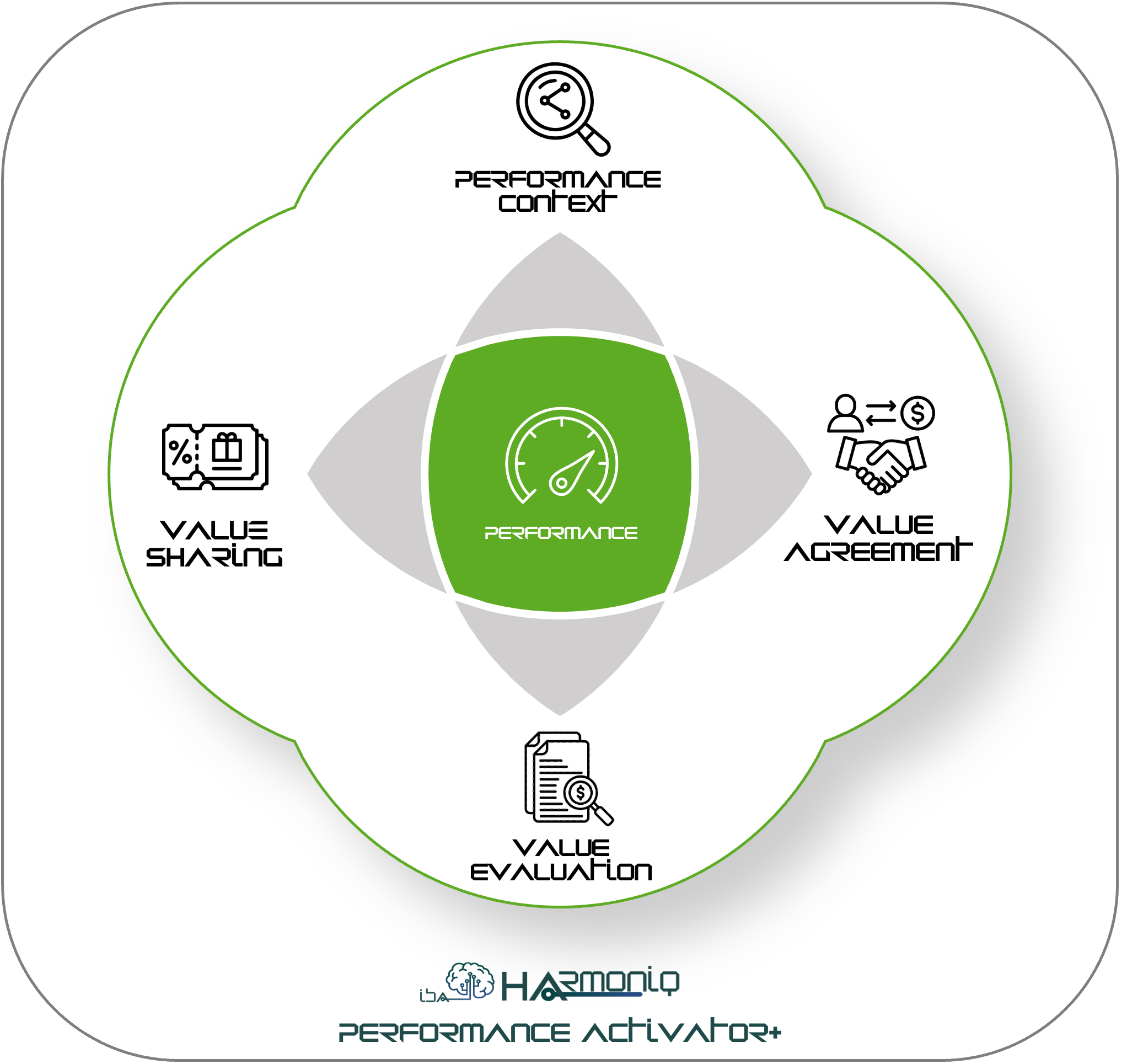
Operational activation in the field takes place through four Performance Activator+
- Performance Context: characteristics of the specific performance context.
- Value Agreement: makes explicit the exchange of value between the actors involved in the specific performance context.
- Value Evaluation: measurement of the value created.
- Value Sharing: how to share the value created and quantify rewards.
1. Performance Context
A Performance Context defines the specific and unique situation in which people (and virtual players) find themselves acting.
Harmoniq maps and monitors performance on four different contextual levels:
-
-
- Organization: assesses the global performance and strategic alignment of the entire company through the House of Performance.
- Value Flow (VF): operating flows focused on the customer and the market, evaluated on economic and financial indicators (Turnover, Revenues, Profit, Margin).
- Enabling Process Area (EPA): the enabling process areas that offer internal services. They are evaluated through an EPA Value Score (EVS) based on the effectiveness of the support provided to operational Value Flows.
- Player (Human/AI): the individual Person or the AI Agent.
-
2. Value Agreement
Value Agreement makes it possible to make explicit the exchanges of Value between the actors involved in a specific Performance Context.
Agreements are agreements between multiple organizational relationships and are developed in a bilateral key: "I make X available to you and I expect Y; you commit to creating Z; if Z is created, we share the value according to this rule".
This leads Value Agreements to develop a relationship: Commitment ↔ Enablement ↔ Value ↔ Sharing and not: Target → Evaluation → Bonus, linked instead to a relationship: "you have to get these results."
3. Value Evaluation
The Value Evaluation determines whether the Ambition set for a given context has been hit or exceeded.
In total break with historical budgets and fixed targets, Harmoniq adopts the philosophy of Beyond Budgeting, proposing dynamic, relative and directional objectives.
This mechanism separates the base value (necessary to reach the Performance Threshold) from the extraordinary value (extra) neutralizing the phenomenon of "sandbagging", i.e. the tendency to negotiate downward targets to make it easy to achieve them.
4. Value Sharing
Value Sharing (or Value-added sharing) is the meritocratic and market-oriented incentive system that espouses the Paid by User philosophy: all nodes and players that concretely contribute to the Value-To-Market release chain have the right to retain and distribute a share of the profits generated.
Sustainability and Operational Consequences of Statuses
Continuous monitoring of performance has immediate consequences on the operations of Value Flow, EPA and Player, leading to any urgent corrective actions
Without human intelligence, there is no utility or purpose for artificial intelligence