WAYS OF WORKING (WOW) ENABLER
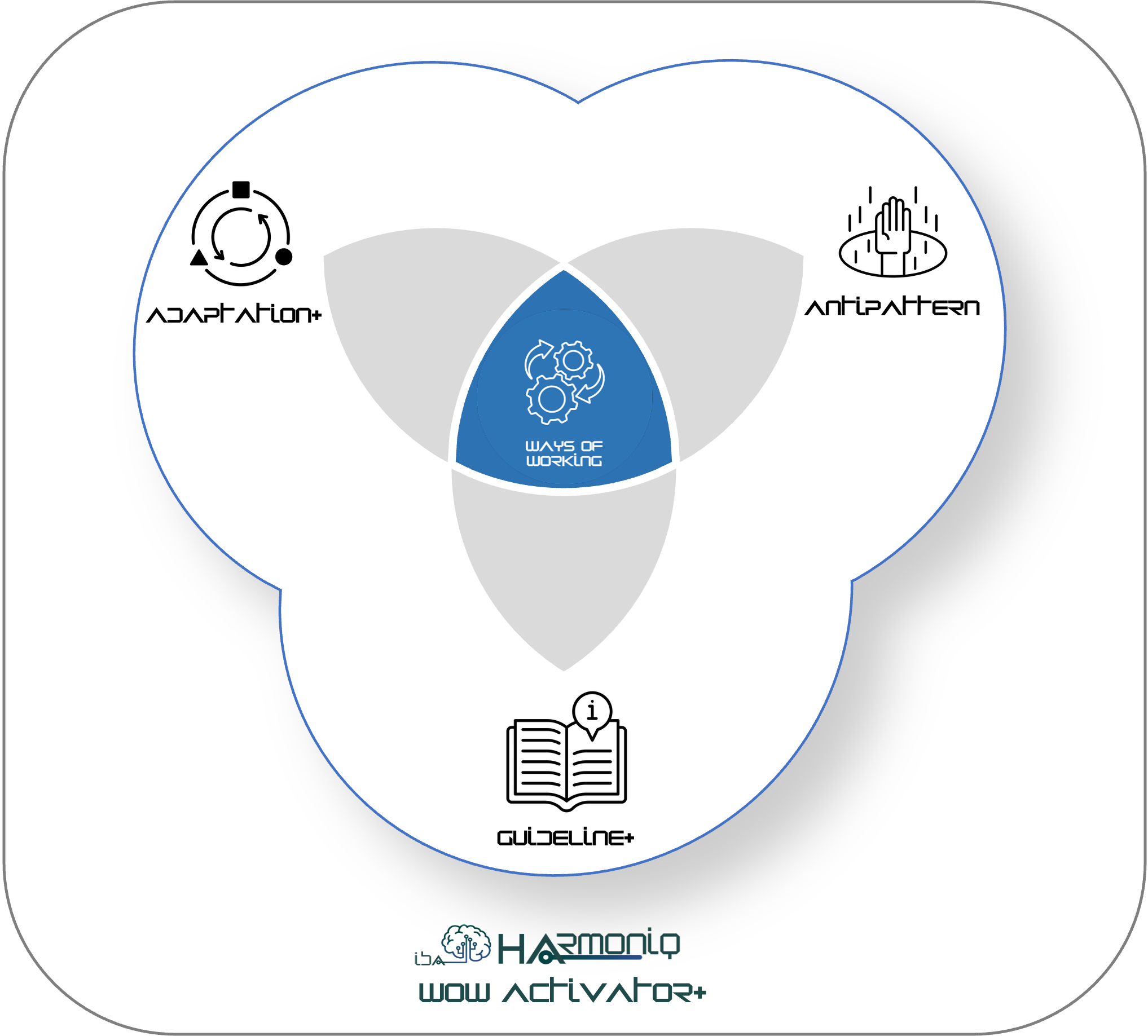
Within the Intelligent Business Agility framework, if the People enabler represents the heart of the organization and Agile Governance ensures its democratic direction, the Way of Working (WoW) enabler constitutes the methodological and operational arm. Its fundamental purpose is to translate the global strategic vision into daily workflows that are fluid, effective, efficient, and highly adaptable.
Harmoniq’s WoW rests on two fundamental pillars: Execution (mastering what is needed, from skills to technicalities, to achieve results effectively) and Adaptation (constantly rethinking oneself to improve performance and the quality of results).
The Three WoW Activators+
The on-the-ground implementation of the Way of Working occurs through the synergetic activation of the three WoW Activators+ defined by the model:
1. Adaptation+: the Flow Accelerators
This activator focuses on the development and proactive influence of the behavior of participants within the corporate ecosystem. It takes concrete form through a structured cycle of Continuous Improvement managed by the Evolutionary Forum+:
-
- Health State Assessment: gathering information on the health state of the company-system and its initiatives allows the identification of constraints thanks to player feedback. This collection can occur through approaches of varying degrees of formality (e.g., Lean Coffee for an open discussion or Retrospective for specific operational topics).
- Activation of Flow Accelerators: once the health state is understood and the main constraints are identified, the Improvement Backlog and experimentation are fed.
2. Antipattern: the Cure Worse Than Evil
An organizational antipattern is a pattern of behavior, structure, or recurrent decision that is adopted to solve a problem but that, in the long run, systematically generates counterproductive consequences, inefficiencies, and rigidity, hindering value creation. An Antipattern, it is distinguished by three key traits:
-
- Initial illusion: it appears as a logical, convenient or intuitive solution.
- Real impact: it produces systemic and recurrent damage (bottlenecks, loss of trust, silos).
- Symptom nature: it is the visible reflection of a deeper structural or cultural defect in the organization.
3. Guideline+: Valuing and Systematizing Success
This consists of a set of guidelines designed to value and systematize the most successful operational methods within the organization. Among the fundamental guidelines to guarantee the effectiveness of the Value Engine are:
-
- Refining Delegation: delegating decisions to the level closest to where the activities actually take place, reducing bureaucracy and waiting times.
- Constant Roadblock Removal: paying constant attention to the main factors of inefficiency (inspired by the theory of constraints) and intervening rapidly to resolve them.
Specifically, Harmoniq defines a set of Guidelines+ divided into a set of fundamental frameworks, derived from the AgileConstellation papers.
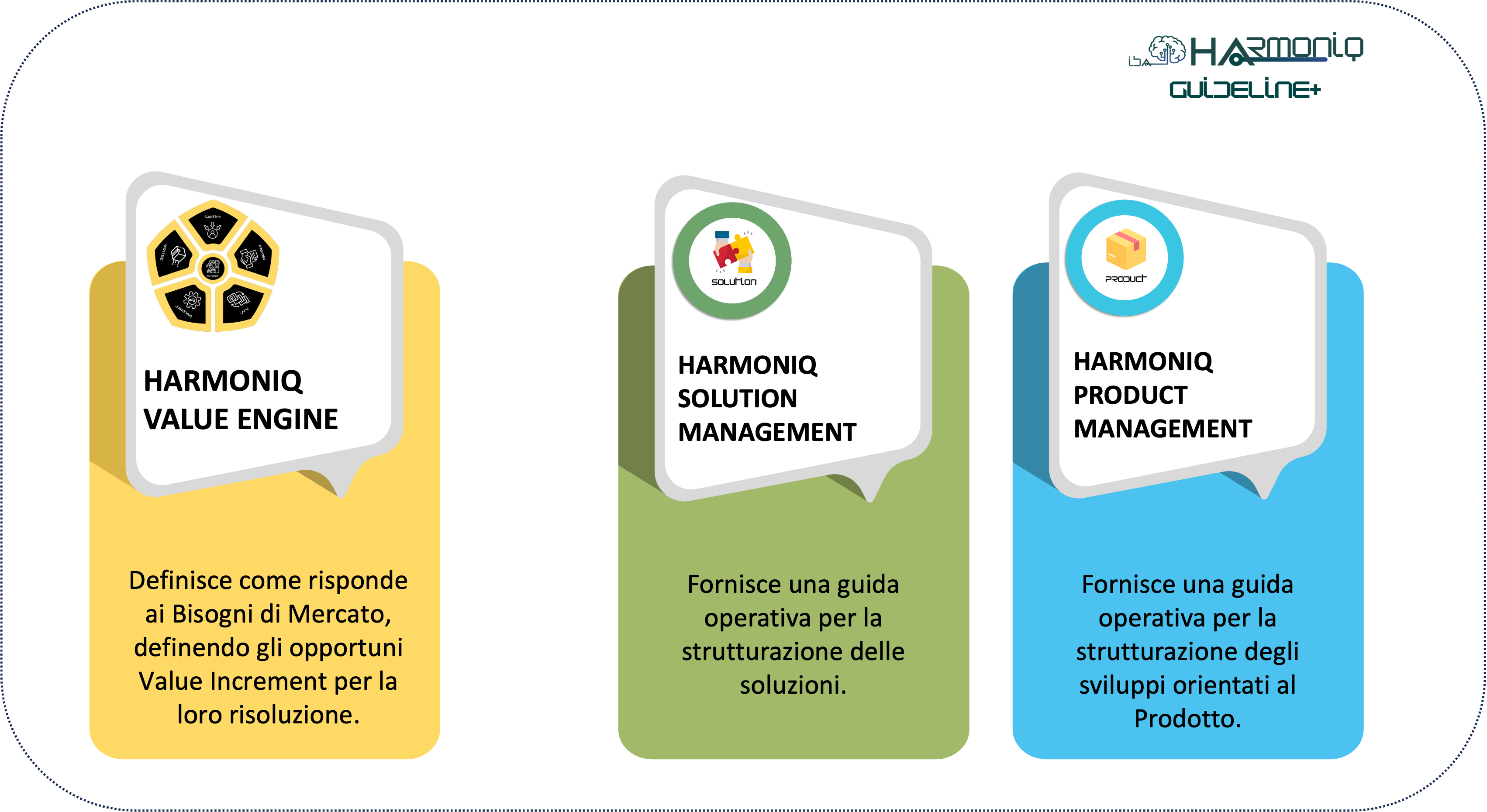
Harmoniq Guideline+
Harmoniq Value Engine (HVE): the Value Trigger
The HVE is the main driver that defines how Value Flow responds to market needs, developing the appropriate Value Increments. It is the process by which an idea or request is transformed into a concrete and financed initiative
The HVE is developed through five fundamental phases:
-
- Identify: collection and review of market and customer needs.
- Propose: define the proposal to meet specific needs.
- Plan: Update the task schedule and Delivery Network+.
- Implement: develop Value Increments through the attached Delivery Items, Products and Solutions.
- Deliver: Release Value Increments, Products and Solutions.
The Two Paths of Execution: Products vs. Solutions
One of the main causes of corporate failure is treating every development the same way. Harmoniq, through its Guidelines, strictly distinguishes between the development of a Solution (Singularity and custom-oriented) and a Product (Continuum and market-oriented).
To manage them, Harmoniq provides two distinct Guidelines:
A. Harmoniq Solution Management (HSM). Provides guidance for Singularity Oriented initiatives (with a defined start, end, and scope for a specific client).
The HSM process unfolds through phases of: Envisioning, Planning, Execution, Monitoring, Closing & Post Go-live. During Planning, HSM introduces powerful tools like the Stacey Diagram to evaluate the level of complexity and uncertainty and the MoSCoW method for prioritizing deliverables.
Above all, it provides a Decision Tree to choose the optimal lifecycle. Not everything must necessarily be Agile: depending on the context, Predictive (Waterfall), Incremental, or Lean approaches can be adopted.
B. Harmoniq Product Management (HPDM). Provides guidance for Continuum Oriented developments (endless, driven by market evolution).
HPDM adopts a radically iterative approach articulated in three phases:
-
- Define: no code is written; exploration happens. Tools like Customer Discovery, Jobs to be Done (JTBD), and Impact Mapping ensure a real problem is being solved.
- Design: idea generation through methods like 6 Thinking Hats or The Anti-Problem, followed by Rapid Prototyping and fast validation.
- Deliver: actual development through Agile approaches, release of the MVP (Minimum Viable Product), and continuous optimization based on real data (e.g., A/B Testing).
Without human intelligence, there is no utility or purpose for artificial intelligence